2025 China GDP Growth Holds at 4.8%: What the Numbers Hide
China’s economy expanded by 4.8% year on year in the third quarter of 2025, according to official data from the National Bureau of Statistics. The number appears stable and aligned with government targets, yet it conceals a deeper story of uneven recovery, weak consumption, and policy trade-offs.
While exports have shown resilience and manufacturing continues to perform well, consumer confidence remains low. The property sector is still shrinking, and local governments are facing fiscal stress. Analysts note that Beijing’s approach of targeted stimulus through monetary easing and infrastructure investment is producing mixed results. The next phase of China’s growth will depend on how successfully policymakers balance stability with reform.
Domestic Demand and Property Sector Remain Weak
The most visible concern in the third quarter report is the weakness in domestic consumption. Retail sales grew only 2.3%, a figure that reflects declining confidence among middle-income households. Rising youth unemployment, officially reported at 14.6% for people aged 16 to 24, has limited the rebound in urban spending.
The property sector continues to weigh heavily on the broader economy. Developers remain under pressure from high debt and tighter credit conditions. Land-sale revenues for local governments have dropped significantly, and property investment fell by about 9% in the quarter. Efforts by the People’s Bank of China (PBoC) to reduce mortgage rates and stimulate housing demand have not yet restored momentum.
To offset this weakness, authorities are channeling funds into infrastructure projects such as high-speed rail, renewable energy, and smart-city logistics. These investments, often structured through public-private partnerships, are helping to stabilize regional economies, especially in inland provinces.
Policy Easing and Fiscal Coordination
In response to slowing growth, the PBoC has adopted a cautious but supportive monetary stance. The loan prime rate has been trimmed twice in 2025, reducing borrowing costs for businesses and households. However, the focus of new credit is shifting toward advanced manufacturing, green technology, and digital infrastructure rather than real estate speculation.
At the fiscal level, Beijing has permitted local administrations to issue special-purpose bonds to finance new industrial projects. Over 1.2 trillion yuan has been mobilized through these instruments, mostly for semiconductor zones, data centers, and renewable power plants.
Economists warn that China’s total debt burden, which now exceeds 290% of GDP, limits the room for large-scale stimulus. This has led to a new policy principle known as quality growth, meaning slower but more sustainable expansion focused on technology, innovation, and employment.
External Trade and Technology Transition
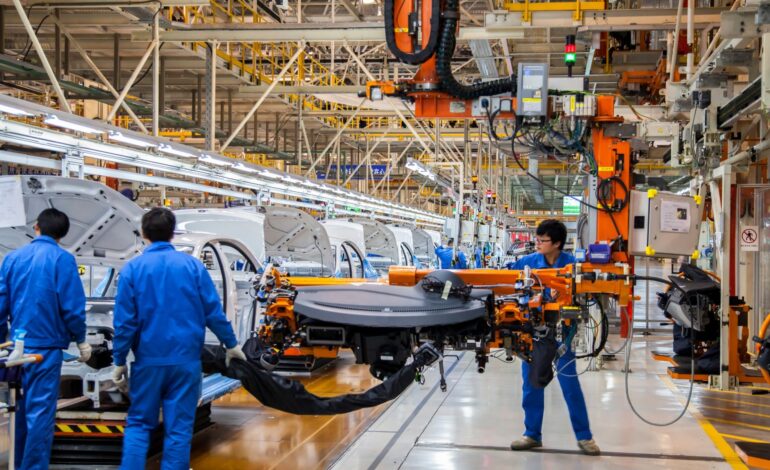
Exports have shown modest improvement, rising 1.8% year on year. Growth has been strongest in electric vehicles, solar components, and high-performance chips, which together reflect the success of China’s industrial upgrading strategy. Traditional export categories such as textiles and consumer electronics, however, remain under pressure.
Tensions with the United States and the European Union continue to shape the trade landscape. New tariffs and carbon border taxes present challenges for exporters. In response, Beijing is deepening partnerships with ASEAN, the Middle East, and African economies through initiatives like the Digital Silk Road. This diversification of trade routes is helping China reduce reliance on Western markets while expanding influence in emerging regions.
At the same time, China’s export controls on critical minerals such as lithium and gallium show that it is willing to use supply-chain leverage as a strategic tool in global competition.
Conclusion
China’s third-quarter growth figure presents a stable surface but conceals significant structural change. The economy is gradually shifting from property and infrastructure dependence toward technology-driven and sustainable growth.
Policymakers are attempting to maintain momentum without triggering financial risks or inflationary pressure. The key test will be how effectively China can integrate industrial reform, green transition, and domestic innovation in the years ahead.
The outlook for 2026 and beyond will depend on whether China can turn this phase of managed deceleration into a platform for durable and inclusive growth.