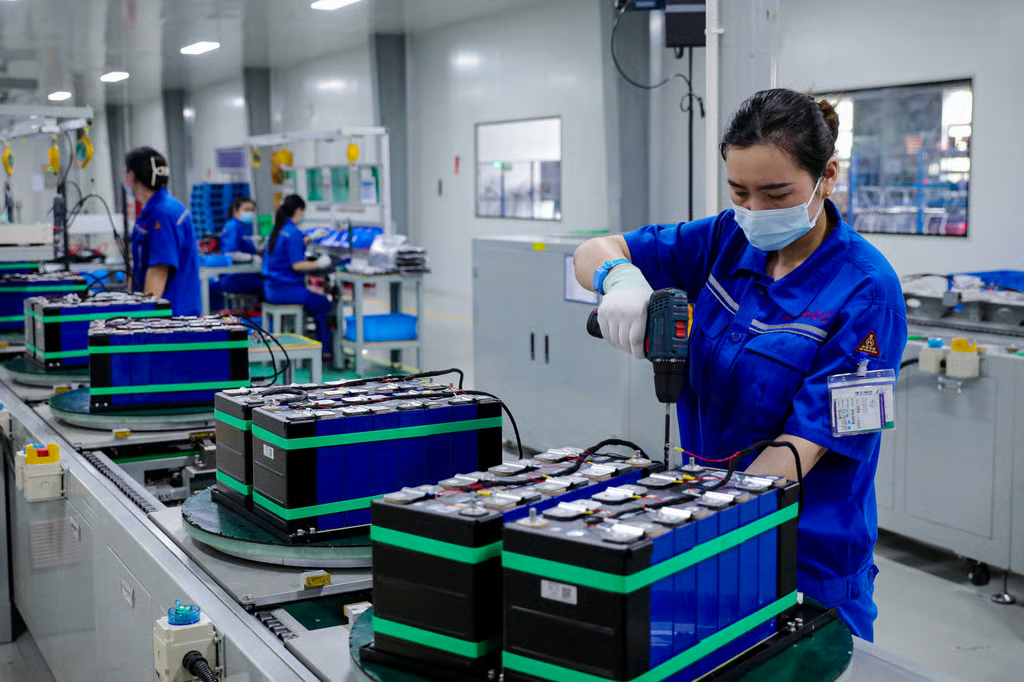
China’s Top Fabs: Building the Heart of the Tech Supply Chain

Semiconductors are often called the “heart of modern technology,” and China’s top fabrication plants, or fabs, are central to building that heart. Over the past decade, China has invested billions in semiconductor fabrication, aiming to reduce reliance on foreign technology and establish a competitive domestic industry. Today, the country’s leading fabs are not just manufacturing chips—they are shaping the global technology supply chain.
At the forefront is SMIC (Semiconductor Manufacturing International Corporation), China’s largest and most advanced chip manufacturer. SMIC produces a wide range of semiconductors, from mature 28-nanometer chips to more advanced 14-nanometer processes. While it still lags behind the most cutting-edge fabs in Taiwan and South Korea, SMIC has become a critical supplier for Chinese electronics companies, powering everything from smartphones to automotive systems.
Another major player is Hua Hong Semiconductor, which specializes in specialty analog and memory chips. Hua Hong focuses on providing high-quality semiconductors for industrial, automotive, and communication applications. By diversifying its offerings, Hua Hong ensures that China’s technology ecosystem has a stable supply of essential components, reducing the risk of dependency on imports.
China’s top fabs are more than just factories—they are innovation hubs. Advanced fabs require precision engineering, ultra-clean environments, and state-of-the-art lithography equipment. Engineers and scientists in these facilities continually refine chip designs, improve yields, and experiment with next-generation processes. Many fabs also partner with universities and research institutions, ensuring that technological advancements move quickly from the lab to production.
Government policy has been a major driver of China’s fab development. Subsidies, tax incentives, and low-interest loans help fabs scale rapidly and reduce production costs. Regional governments also provide land, utilities, and workforce training to attract semiconductor investment. This coordinated approach ensures that fabs can operate efficiently and remain competitive on a global scale.
China’s fabs are also shaping the global supply chain. By increasing domestic production of critical chips, these fabs reduce China’s reliance on imports from Taiwan, South Korea, and the United States. They also support local electronics manufacturers, including EV companies, smartphone brands, and industrial equipment producers, helping China maintain leadership in multiple technology sectors.
Challenges remain, especially in producing the most advanced semiconductors used in high-performance computing and AI. Access to cutting-edge photolithography tools and extreme ultraviolet (EUV) technology is limited, meaning China’s fabs must innovate and collaborate to catch up. Despite these hurdles, the expansion of China’s top fabs demonstrates the country’s commitment to semiconductor self-sufficiency.
In conclusion, China’s leading fabs are at the core of its tech ambitions, driving domestic innovation and reshaping global supply chains. Companies like SMIC and Hua Hong not only produce chips—they are building the infrastructure that powers modern technology, ensuring that China remains a critical player in the semiconductor world.
Tags: