AI Infrastructure Becomes Defining Global Investment Cycle Says Nvidia CEO
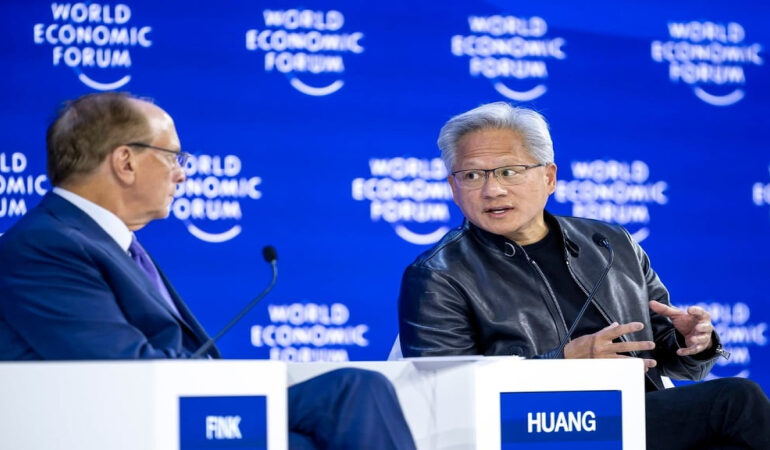
The global economy has entered what may become the largest infrastructure buildout in history as artificial intelligence reshapes how nations invest, compete and plan for growth, according to Nvidia chief executive Jensen Huang. Speaking at the World Economic Forum in Davos, Huang said hundreds of billions of dollars have already been deployed to build the foundations of AI systems, with trillions more required in the years ahead. He described artificial intelligence as a layered infrastructure stack beginning with energy and chips and extending through cloud platforms, models and applications. The scale of investment reflects a shift in how governments and companies view AI, no longer as a niche technology but as core national infrastructure. Huang’s remarks highlighted how AI spending is increasingly treated alongside power grids, transport networks and digital connectivity as a prerequisite for long term competitiveness and economic resilience.
Huang also argued that the next phase of AI development will be shaped by national strategies rather than purely global platforms. He said countries should build their own AI systems that reflect local languages, data and cultural contexts, rather than relying exclusively on foreign models. This approach, he suggested, would allow governments to maintain greater control over technology that is rapidly becoming embedded in public services, education and industry. The comments come as many countries weigh sovereignty concerns alongside the benefits of scale offered by large global providers. The emphasis on national AI systems aligns with broader trends toward localisation of digital infrastructure and data governance. For policymakers, the challenge lies in balancing openness and innovation with control and security as AI capabilities diffuse across borders.
Addressing concerns about job losses, Huang sought to reassure audiences that AI would transform work rather than eliminate it outright. He argued that productivity gains driven by AI could create new roles and industries even as certain tasks become automated. However, he acknowledged that the transition would require significant adaptation in education and workforce training. Energy availability emerged as a critical constraint, with Huang noting that power generation is becoming a central bottleneck in AI expansion. Governments are increasingly factoring energy policy into AI strategies as data centres and computing demands surge. Taken together, the remarks underscored how artificial intelligence is no longer simply a technology story but a structural force reshaping investment, labour and national policy priorities worldwide.