Chinese Robotic Dog Sparks Controversy at India AI Summit, University Booth Removed
An artificial intelligence summit in New Delhi was overshadowed this week after a private Indian university was asked to remove its exhibition booth over claims surrounding a robotic dog that was later identified as a commercially available Chinese product.
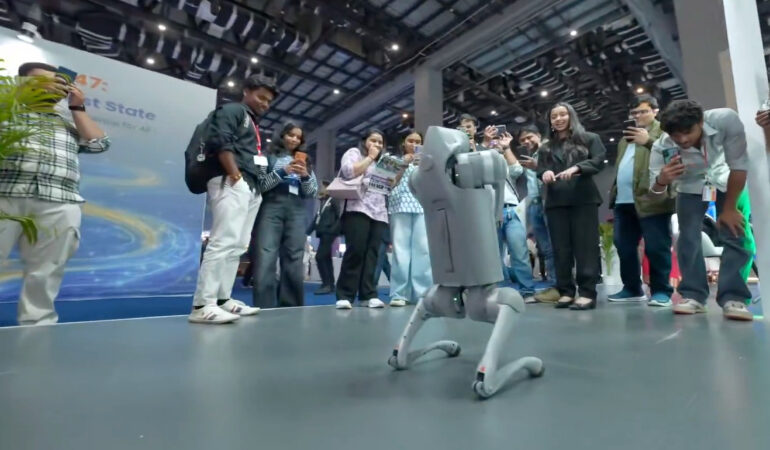
The incident unfolded at the India AI Impact Summit, a high profile event attended by global technology leaders, heads of state, and industry executives. A representative from Galgotias University presented a quadruped robotic dog named Orion and described it during a media interaction as being developed by the university’s Centre of Excellence. Shortly after the remarks were broadcast, online users pointed out that the robot closely resembled the Unitree Go2, a model produced by China based robotics firm Unitree Robotics and widely sold for research and educational purposes.
The Unitree Go2 is a commercially available robotic platform used globally in laboratories, universities, and robotics startups. With a starting price accessible to educational institutions, it has become a common tool for experimentation in mobility algorithms, machine vision, and autonomous navigation. Images and specifications shared online appeared to match the model displayed at the summit.
According to officials familiar with the matter, summit organizers directed the university to take down its pavilion following the controversy. The episode quickly gained traction on social media, raising questions about representation, transparency, and the verification of technological claims at major innovation events.
In a subsequent clarification, the university stated that its staff member had not intended to claim original development of the hardware itself. It described the situation as a misunderstanding and later issued an apology, noting that the representative was not authorized to speak to the media and was unaware of the technical origins of the robotic platform. The institution emphasized that students were using globally available technologies as part of their learning and innovation efforts.
The controversy comes at a sensitive time for India as it seeks to position itself as a leading hub for artificial intelligence, robotics, and advanced manufacturing. The AI Impact Summit has been promoted as a flagship gathering for the Global South, drawing participation from senior policymakers and executives from major global technology firms. With billions of dollars in potential investments tied to India’s digital economy ambitions, credibility and authenticity remain central to its positioning strategy.
Beyond the individual incident, the episode highlights broader challenges facing emerging innovation ecosystems. As universities and startups integrate imported hardware platforms into domestic research programs, clear communication about what constitutes original design versus applied experimentation becomes increasingly important.
With robotics and AI development accelerating across Asia, both India and China are competing to shape narratives around technological leadership. Events such as this underscore the scrutiny placed on institutions seeking to showcase innovation on the global stage.