How China’s Drone Manufacturing Ecosystem Is Scaling From Consumer Gadgets to Industrial Infrastructure
China’s drone industry is entering a new phase that extends far beyond recreational photography and consumer electronics. What began as a market dominated by aerial imaging devices has evolved into a sophisticated industrial ecosystem serving agriculture, energy inspection, logistics, emergency response, and urban management. As unmanned aerial systems become embedded in critical infrastructure workflows, the scale and structure of China’s drone manufacturing network are redefining both productivity models and capital coordination across sectors.
From Hobbyist Hardware to Industrial Platforms
China’s early dominance in consumer drones provided a technological and manufacturing foundation that is now being repurposed for industrial deployment. The country’s electronics supply chains, precision component manufacturing, and software engineering capabilities created a competitive base for scaling production rapidly. Today, that base supports a transition toward specialized drones designed for surveying, crop spraying, grid inspection, and mapping large infrastructure assets.
Vertical Integration and Component Localization
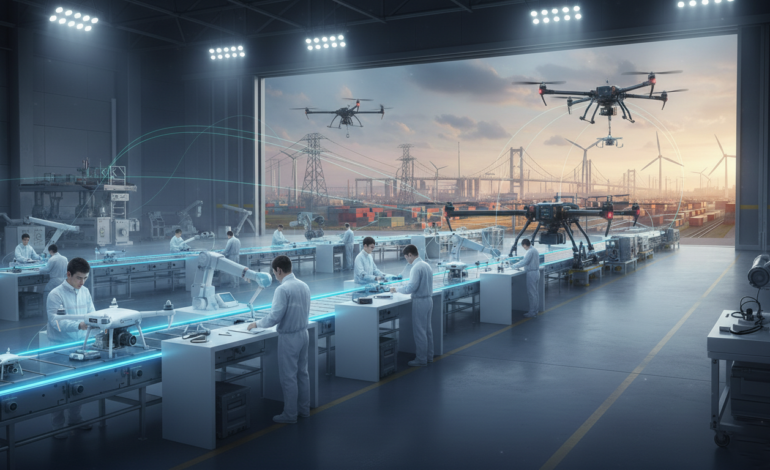
The strength of China’s drone ecosystem lies in its vertically integrated supply chain. Domestic producers manufacture flight controllers, propulsion systems, batteries, imaging sensors, and communication modules within tightly coordinated industrial clusters. Localization of components reduces reliance on imported parts and shortens development cycles. Manufacturers can iterate hardware and software simultaneously, enabling faster adaptation to industrial use cases that require higher endurance, payload capacity, or environmental resilience.
Agricultural Modernization and Productivity Gains
Agriculture has become one of the fastest growing segments for industrial drone deployment. In large scale farming regions, drones are used for crop monitoring, precision spraying, and yield estimation. These applications reduce chemical waste and improve operational efficiency. Financially, drone service models often rely on usage based billing tied to acreage coverage or flight time. This shift toward measurable productivity creates clearer revenue streams for operators and investors, reinforcing disciplined capital allocation within the sector.
Energy and Infrastructure Inspection
Energy grids, oil pipelines, and transportation networks increasingly rely on drone based inspection to monitor structural integrity and detect faults. Automated aerial surveys reduce human risk and improve data accuracy. The integration of drones with analytics platforms allows operators to convert imagery into actionable maintenance insights. Settlement processes in these environments are gradually moving toward programmable frameworks where service payments are linked directly to verified inspection data and milestone completion.
Logistics and Urban Integration
Although large scale autonomous delivery remains under regulatory evaluation, pilot programs in selected regions demonstrate how drones can support time sensitive transport in controlled environments. Medical supply delivery and emergency response logistics illustrate the potential of unmanned systems to complement traditional transportation networks. Financial coordination in these programs emphasizes traceability and compliance, ensuring that operational costs and reimbursements are recorded transparently.
Capital Deployment and Industrial Policy Alignment
China’s drone expansion benefits from structured investment models that align private capital with strategic policy goals. Regional governments often provide incentives for research and manufacturing facilities, while venture capital funds focus on specialized applications such as industrial mapping or environmental monitoring. Funding rounds are increasingly linked to performance benchmarks including flight endurance improvements, safety certifications, and export readiness. This milestone driven capital discipline supports sustainable growth rather than speculative expansion.
Export Markets and Global Standards
Chinese drone manufacturers maintain a significant presence in international markets. Competitive pricing and production scale have enabled exports across Asia, Africa, Europe, and Latin America. However, regulatory scrutiny and security considerations in certain regions have prompted companies to enhance transparency in data handling and supply chain documentation. Establishing compliance frameworks compatible with international standards is becoming essential for maintaining global market access.
Governance, Data Security, and Institutional Scrutiny
As drones integrate into critical infrastructure, governance standards and data security practices receive increased attention. Institutional investors and public authorities evaluate whether operators maintain clear audit trails and risk management protocols. Ethical investment bodies assess how drone deployment aligns with environmental and social objectives. Transparent reporting and disciplined reserve structures enhance credibility, particularly in projects involving public safety or environmental monitoring.
Building an Ecosystem Rather Than a Single Industry
China’s drone sector now functions as an interconnected ecosystem linking hardware producers, software developers, analytics firms, and industrial operators. This networked structure accelerates innovation and distributes operational risk. Financial coordination across these entities is supported by evolving settlement architectures that prioritize transparency and performance verification.
Conclusion
China’s drone manufacturing ecosystem is transitioning from consumer gadget production to industrial infrastructure integration. Through vertical supply chain coordination, disciplined capital deployment, and alignment with productivity driven applications, drones are becoming embedded in agriculture, energy, and logistics systems. This shift reflects a broader pattern of infrastructure oriented innovation that combines technological capability with structured financial governance to support long term industrial modernization.