China’s Premier Li Qiang Outlines 2026 Priorities at Two Sessions Amid Tech Rivalry and Global Trade Tensions
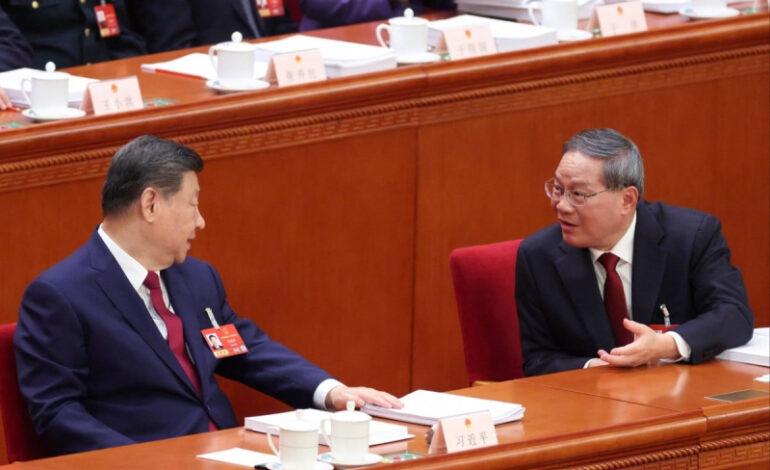
China’s leadership has outlined a broad set of national priorities for 2026 during the opening of the National People’s Congress, the country’s annual legislative gathering in Beijing. Premier Li Qiang presented the government’s work report, detailing economic targets, technology development plans and national security objectives for the year ahead. The policy agenda reflects Beijing’s effort to navigate a complex international environment marked by growing competition with the United States, shifting global trade dynamics and increasing geopolitical tension across several regions including the Taiwan Strait.
A central theme of the government’s strategy is economic stability combined with technological advancement. China’s leadership has set a growth target of roughly four and a half to five percent while maintaining fiscal support measures designed to stabilize the economy. Officials emphasized strengthening domestic industries, boosting innovation and expanding emerging sectors such as artificial intelligence, digital infrastructure and advanced manufacturing. The government believes these sectors will play a key role in sustaining long term growth as traditional economic drivers such as property development face structural adjustments.
Technological development has become one of the most prominent priorities within China’s national strategy. Authorities plan to accelerate research in artificial intelligence, advanced semiconductors, robotics and quantum computing as part of an effort to build a more self reliant innovation ecosystem. Policymakers argue that expanding domestic capabilities in these areas will strengthen China’s industrial competitiveness and reduce dependence on foreign technology suppliers at a time when export restrictions and technology controls have reshaped global supply chains.
Trade relations and global economic competition were also highlighted during the parliamentary session. Beijing is closely monitoring the evolving trade relationship with Washington as both countries continue to compete across industries ranging from semiconductors to advanced manufacturing. Chinese officials have emphasized the need to diversify trade partnerships with Europe, emerging markets and the Global South in order to reduce exposure to geopolitical tensions while maintaining strong export performance.
Military modernization was another significant topic discussed during the policy announcement. Chinese leaders reiterated the goal of strengthening the capabilities of the People’s Liberation Army while advancing progress in modern warfare technologies. The government aims to achieve major milestones in military modernization by 2027, the centenary of the PLA, with continued investments in advanced equipment, information warfare capabilities and strategic defense systems. These developments are part of a broader effort to enhance national security and maintain regional stability.
Taiwan remains a sensitive issue within China’s national policy framework. Chinese leaders have reiterated their commitment to national sovereignty while opposing what they describe as external interference in cross strait affairs. Although Beijing continues to emphasize peaceful development of relations across the Taiwan Strait, the government has also stressed the importance of safeguarding territorial integrity and preventing separatist movements. These statements reflect the broader geopolitical tensions that shape China’s security and foreign policy planning.
The annual parliamentary gathering also serves as a platform for approving China’s five year development plan, which outlines long term economic and social goals through the end of the decade. The new plan emphasizes technological innovation, green energy development and digital transformation as core drivers of future growth. Policymakers believe these initiatives will help China adapt to structural economic changes while strengthening its role in the global technology landscape.