Beijing robotics lab pushes humanoid machines through real world endurance tests
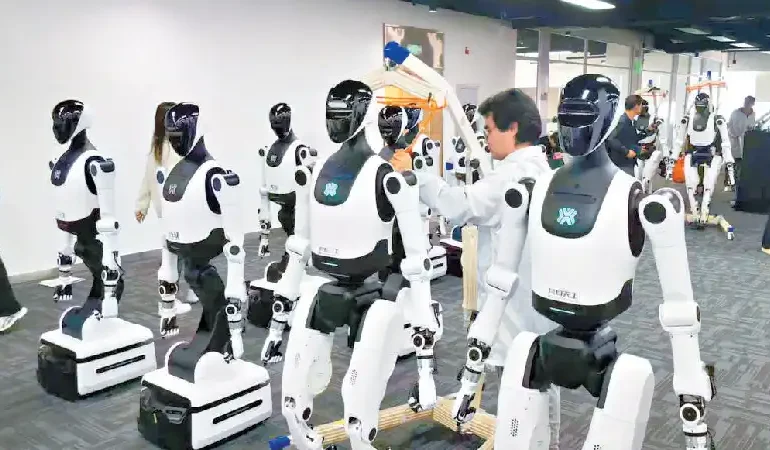
Inside a high intensity robotics laboratory in Beijing, engineers are subjecting humanoid robots to rigorous endurance testing as China accelerates efforts to bring advanced robotics into real world environments. The facility operated by X Humanoid focuses on preparing machines for unpredictable human settings, where stability, adaptability, and long duration performance are critical. These tests reflect a broader shift in China’s robotics sector from prototype development toward deployment readiness, as companies race to commercialize humanoid systems capable of operating across industries such as manufacturing, logistics, and service environments.
Engineers at the lab are running robots through extended movement cycles designed to simulate real working conditions, including walking, lifting, balancing, and task repetition over long periods. The goal is to identify mechanical weaknesses and improve system reliability before large scale rollout. Humanoid robots must handle complex interactions with dynamic surroundings, making endurance testing essential for ensuring safety and operational consistency. The machines are also being evaluated under different environmental conditions, helping engineers refine control systems and hardware durability in scenarios that mirror real world deployment challenges.
Researchers explain that building a humanoid robot capable of functioning outside controlled environments requires a combination of advanced sensors, precise motor control, and intelligent decision making systems. Each component must operate seamlessly under stress, especially when robots are expected to perform repetitive tasks without failure. Engineers are focusing on improving joint flexibility, battery efficiency, and motion accuracy, all of which play a key role in extending operational time. The testing process also helps fine tune artificial intelligence models that guide movement and interaction, ensuring that robots can adapt to unexpected changes in their surroundings.
Developers at X Humanoid emphasize that endurance trials are not only about hardware resilience but also about software learning and behavioral refinement. Engineers note that repeated testing allows systems to gather data on movement patterns, error rates, and energy consumption, which can then be used to optimize performance. They highlight that preparing robots for public environments requires meeting strict safety thresholds, particularly in settings where machines may interact closely with humans. This has led to increased focus on fail safe mechanisms and responsive control systems that can quickly adjust to avoid potential risks.
China’s push into humanoid robotics has gained momentum in recent years as both private companies and research institutions invest heavily in next generation automation technologies. The country aims to position itself as a global leader in robotics by combining advances in artificial intelligence with large scale manufacturing capabilities. Humanoid robots are seen as a key frontier, with potential applications ranging from industrial support roles to healthcare assistance and urban services. The emphasis on real world testing reflects a strategic effort to move beyond experimental models toward commercially viable systems.
Beyond individual labs, the broader robotics ecosystem in China is evolving rapidly, supported by government policies that encourage innovation and industrial integration. Companies are collaborating with universities and technology partners to accelerate development cycles and bring products to market faster. At the same time, global competition in robotics is intensifying, with firms in the United States, Europe, and Asia all working to advance humanoid capabilities. This competitive environment is driving faster iteration and higher performance standards across the industry.
Recent developments suggest that endurance testing is becoming a defining stage in the robotics development pipeline, as companies seek to demonstrate reliability at scale. Firms are increasingly showcasing real world performance metrics to attract investment and secure commercial partnerships. In Beijing’s lab, the ongoing trials provide a glimpse into how humanoid robots are being prepared for broader deployment, with engineers continuing to refine systems that must operate safely and efficiently in complex, human centered environments.