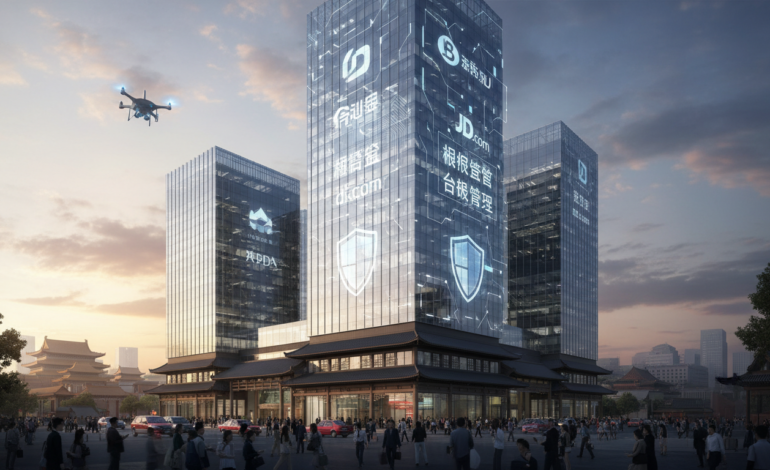
Private Firms Reshape China Defense Tech Under Sanctions

China’s Defense Strategy and Private Sector Role
Policy signals this week show Beijing pressing private industry deeper into military supply chains. At the National University of Defense Technology, a PLA general argued that commercial firms can prevent external pressure from choking procurement and research, according to the South China Morning Post. Today, executives in chips, avionics, and industrial software are being asked to align road maps with military requirements while preserving commercial competitiveness. The push is framed as a resilience play as well as an efficiency drive that could shorten development cycles. Live discussions inside Chinese industry associations now focus on compliance systems and secure contracting so smaller vendors can participate without exposing sensitive data. Update briefings to investors increasingly reference dual use product lines and defense related customer demand.
Western Sanctions Impact on China’s Technology
Export controls and entity listings are forcing redesigns in components, tooling, and even documentation practices for sensitive programs. Western sanctions are not described publicly with precise program level losses, but the same NUDT remarks cited by the South China Morning Post tie urgency to tightening restrictions. In a separate window on security concerns, the South China Morning Post UK spying case coverage illustrates how technology transfer and commercial links are scrutinized in Western courts. Today, procurement teams inside major contractors are prioritizing domestic substitutes and parallel suppliers to reduce single points of failure. Live testing schedules can slip when a restricted toolchain breaks validation, so engineering groups are building more redundant qualification paths. Update notes from Chinese policy commentators also emphasize that restrictions can raise costs by pushing firms to requalify entire subsystems.
Innovation and Collaboration with Private Firms
New collaboration models are emerging that resemble venture procurement rather than classic state bidding. Defense innovation programs are increasingly scouting mature commercial products that can be adapted under controlled interfaces, instead of funding bespoke platforms from scratch. A visible example of wider trade and logistics planning appears in China-Pakistan Trade Faces Hormuz Security Shock, where supply resilience is treated as a strategic variable that can influence technology access and transport risk. Today, the private sector role is often justified in terms of rapid prototyping, manufacturing discipline, and software iteration speed. Live pilots in autonomy, sensors, and secure communications can be scaled faster when commercial quality systems already exist. Update cycles are also shorter when firms can run continuous integration pipelines in house and deliver incremental capability without waiting for long procurement windows.
Challenges Facing China’s Defense Technology
Closer civil military integration creates governance and security problems that private companies must solve quickly. Contracting rules can pull founders into sensitive work while exposing them to compliance risk if customer requirements are ambiguous or change midstream. Today, corporate counsel in China is building export control and data security programs to separate defense projects from global business lines. Live engineering collaboration can also be slowed by classification barriers that limit what private teams are allowed to see, pushing state integrators to do extra translation work. For context on how service restrictions can hit cross border operations, MiroMind Halts China Services Amid AI Tensions shows how geopolitical pressure can force firms to adjust product availability. Update driven security audits are becoming routine, and they can stretch timelines if vendors lack mature documentation and testing evidence.
Future Prospects for China’s Defense Technology
The near term trajectory points toward more standardized pathways for private vendors, with clearer technical baselines and repeatable security accreditation. Planners for China defense technology are likely to focus on areas where commercial scale can outpace restrictions, such as industrial software, robotics, and manufacturing equipment, while more specialized components stay within state controlled lines. Today, officials and academics linked to the national university of defense technology are using public forums to argue that innovation speed matters as much as raw spending, as described by the South China Morning Post. Live market signals also matter because private firms will not invest without predictable demand and payment. Update messaging from regulators is expected to emphasize procurement transparency and intellectual property protection so smaller suppliers can participate without losing core know how. The outcome will hinge on whether integration increases speed without creating new security weak points.