China AI robotics deploys needle-free pig vaccines
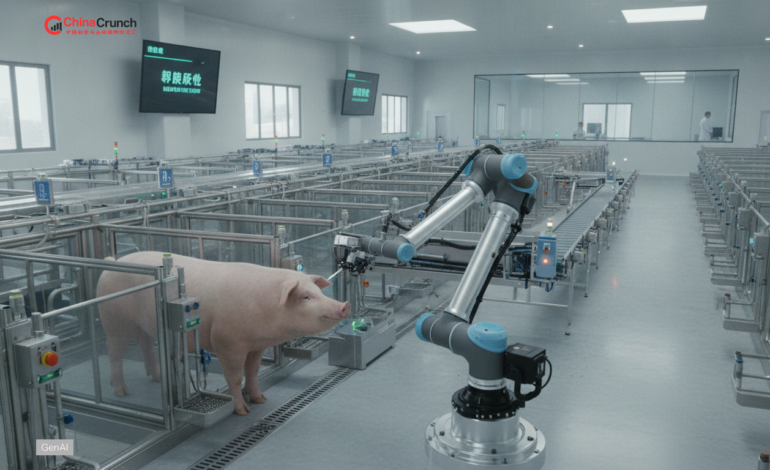
China AI robotics brings needle-free pig vaccination robots
Commercial hog producers in China may be testing automation for routine health tasks on large farms, including a new robot focused on vaccine delivery. In barn conditions, consistent handling and repeatable motion can matter as much as software. In a needle free approach, machine vision helps locate an injection zone and reduce human contact with animals during processing. Farms adopting such tools may tie robot logs to herd records to support compliance and traceability, and the “93% accuracy” figure is described by the developer in its product briefing as correct targeting and successful delivery rather than disease outcomes, and should be read as a vendor-stated performance metric.
How needle-free vaccination robots work in pig farms
Needle free vaccination devices may rely on a high pressure jet to deliver a measured dose through the skin without leaving a needle in the animal. In this implementation, a robotic arm positions the applicator after cameras confirm orientation and distance, then software checks that the animal is within a safe motion window before firing the dose, and for component readiness, the South China Morning Post detailed upstream capacity in China’s MLCC supply chain expanding rapidly amid surge in global AI demand. Operators still typically verify dose calibration at the start of each run. The broader push toward automation is discussed in China AI workforce: how automation is reshaping jobs, which highlights how task design changes when robots enter production settings.
Benefits for biosecurity, traceability, and throughput
Farms adopting intelligent pig farming systems often prioritize throughput, repeatability, and reduced cross contamination during handling. Removing needles can help lower the chance of broken needle fragments in carcasses and can reduce sharps management burdens for staff, while the robot’s logs can provide time stamps and batch references for audits. For investors tracking adoption signals, agricultural automation is sometimes discussed alongside broader China AI robotics themes and sector positioning such as a china ai etf, even when farm deployments are only one application area, and guidance on how domestic AI revenue expectations are framed appears in China AI revenue seen hitting US$13b, Goldman says. Production managers increasingly pair these records with wider analytics, including how robotics changes labor allocation and cost planning for each barn.
Key robotics innovations behind the vaccination workflow
What differentiates the vaccination robot is the integration of sensing, motion control, and dose delivery into a single workflow that can be audited. Vision models handle detection under uneven barn lighting, while control software plans approach paths that reduce startling movements around animals. Hardware supply depth matters because actuators, capacitors, and control boards need stable procurement for scale, and the South China Morning Post described rising demand pressures across manufacturing inputs in Unrelenting AI demand spawns new plant for Chinese PCB maker Victory Giant. For farm use, ruggedized housings and wash down protection are as critical as algorithms.
What comes next for China AI robotics in agriculture
Near term expansion is expected to center on scaling deployments across high density operations, where biosecurity protocols reward consistent execution. In agriculture, vendors are positioning vaccination as one node in a wider stack that can include weighing, sorting, and environmental monitoring, with each device feeding shared data systems, and China AI robotics is increasingly framed as part of that integrated workflow rather than a single machine. Regulators and buyers increasingly demand traceable health interventions, so systems that automatically record who, what, and when can reduce paperwork and limit errors. Capital markets interest, including themes grouped under a china ai etf, will likely follow evidence of repeatable unit economics rather than vendor performance claims alone. For related robotics market context, see SpaceX IPO Hong Kong: Lessons From X Square Robot. Adoption also depends on service networks that can maintain calibration and replace wear parts quickly.