Advanced chip production in China set to surge by 2035
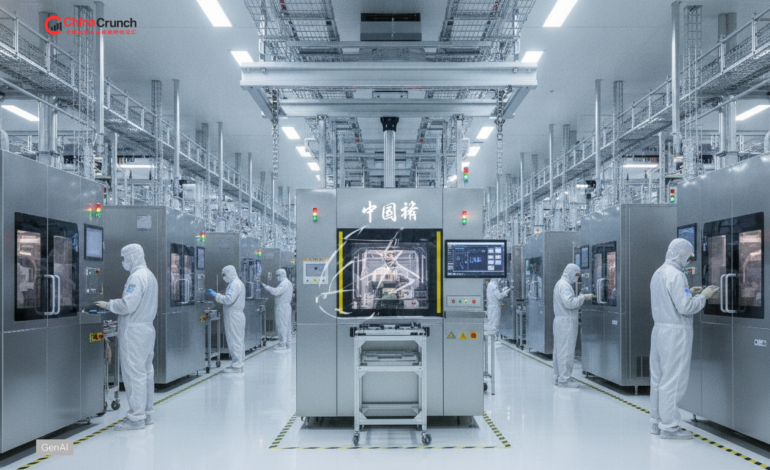
Advanced chip production outlook: Goldman sees 2035 surge
Advanced chip production in China could surge by 2035 even as semiconductor bottlenecks persist and access to leading tools stays tight, according to Goldman Sachs. In research mentioned by the South China Morning Post, the bank suggests that capacity additions, yield improvements, and process learning can potentially compound over time across domestic foundries. Rather than relying on a single breakthrough at the most advanced node, the projection emphasizes incremental gains in output and reliability that build year after year. That matters for procurement and product teams because advanced chip production qualification cycles, redundancy planning, and multi year supply agreements depend on predictable shipment consistency. The 2035 horizon also signals that the expected ramp is structural, tied to investment and operational execution, not short term policy noise.
Constraints on advanced chip production
One of the primary challenges in the near term is restricted access to certain lithography and related process tools, along with the necessary parts and service ecosystem that keeps lines running. In the South China Morning Post summary of Goldman’s view, equipment bottlenecks are described as a significant limiter on how quickly China can expand the most advanced lines, and for context on how Beijing balances industrial priorities and funding across sectors, see Pakistan energy projects: China reshapes funding and grid. Even so, Goldman’s argument is that output can still rise through higher utilization of installed tools, tighter process control, and yield improvements, while some demand shifts to slightly older nodes that are still considered advanced for many end uses. Constraints remain real, but operational discipline can still expand effective capacity.
Policy and domestic supply chains behind advanced chip production
Beijing’s strategy is to strengthen supply chains and increase domestic substitution across materials, equipment, and design. In that framework, advanced chip production is treated as an industrial capability supported by fab clusters, supplier qualification programs, and sustained capital spending. Goldman’s thesis, as reported by the South China Morning Post, focuses on cumulative learning across multiple nodes, not only the smallest geometries. Demand pull also matters: cloud, automotive, and industrial buyers often need reliable volume, stable specs, and predictable delivery more than headline node leadership. A parallel push in embodied systems and robotics points to broader compute demand, covered in Xpeng robotics funding: $900m war chest for embodied AI, and telecom monetization efforts add another demand channel in AI token factories: China telecoms push new revenue. The strategic goal is resilience through volume, redundancy, and local supplier depth.
Market impact if China expands advanced chip production
If China delivers the chip supply growth Goldman anticipates by 2035, effects could show up in pricing, qualification standards, and procurement strategies across Asia and beyond. Greater domestic availability can reduce import exposure for Chinese device and industrial firms, while increasing competitive pressure in segments where suppliers compete on cost, capacity, and delivery reliability, as advanced chip production scales in parallel with those procurement shifts. Goldman’s view, cited by the South China Morning Post, implies that incremental output gains could accumulate into a material share of global supply in selected categories by 2035, even if the frontier remains constrained by tools. Competitors may respond by differentiating through packaging, specialized process technologies, or long term customer integration. For multinationals, a practical question is how to segment sourcing to manage compliance and continuity without sacrificing performance, especially when the same product line may serve multiple markets.
Sources, milestones, and verifiable signals to watch
Goldman’s projection is reported by the South China Morning Post and centers on a 2035 timeframe, with bottlenecks in equipment access still highlighted as a key constraint. Readers can review the cited write up directly here: China’s advanced chip supply to surge by 2035 despite equipment bottlenecks, Goldman says, which frames the same advanced chip production timeline as a cumulative ramp rather than a single node leap. To judge whether advanced chip production is tracking the path implied in that report, the most verifiable signals are operational: sustained wafer starts, improving yields, higher tool uptime, and more frequent customer qualifications for high volume manufacturing. Concrete milestones typically show up as steadier shipment consistency, fewer requalification cycles, and improved defect density in production runs, rather than one headline node announcement. Progress also depends on hiring and retaining process engineers, tool technicians, and integration specialists, because iteration and execution drive most compounding gains.