High-Tech Manufacturing Boost: China Aims to Maintain Industry Share as Demand Weakens
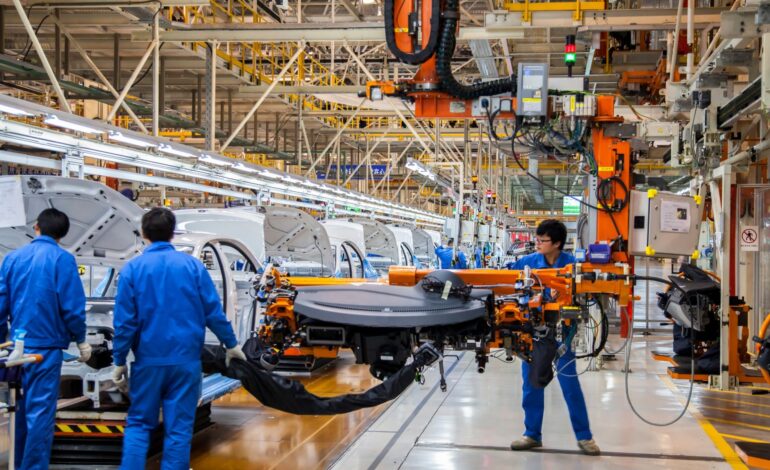
China’s manufacturing sector once the unchallenged engine of global industrial growth is facing a crucial test. As domestic consumption slows and global demand softens, Beijing is doubling down on high-tech manufacturing to sustain growth and defend its share of the global supply chain. According to Bloomberg, policymakers are intensifying incentives for robotics, EVs, advanced materials, and smart production systems, betting that industrial modernization can offset weaker exports and consumer spending.
The shift signals a deeper transformation: China is no longer content with being the “world’s factory” it is striving to become the world’s innovation hub, integrating artificial intelligence, automation, and data-driven production into every layer of its economy.
Beijing’s Push for High-End Industrial Resilience
In recent months, China’s State Council and Ministry of Industry and Information Technology (MIIT) have unveiled a series of initiatives designed to stabilize the manufacturing base. This includes extending tax breaks for high-tech firms, subsidizing domestic equipment upgrades, and promoting digital twins and industrial IoT adoption.
Central to this strategy is “Advanced Manufacturing Clusters” regional innovation hubs designed to merge academia, startups, and supply chain players. These clusters are being piloted in Shenzhen, Suzhou, and Chengdu, focusing on semiconductors, robotics, EV batteries, and precision machinery. By embedding AI analytics and real-time production monitoring, Beijing hopes to transform these zones into self-sustaining innovation ecosystems that can compete globally.
While traditional manufacturing textiles, steel, and real estate-linked sectors faces contraction, high-end manufacturing has remained robust, growing over 6% in 2025 according to China’s National Bureau of Statistics. This resilience reflects China’s pivot from labor-driven exports to technology-led competitiveness.
The Role of AI and Digital Infrastructure in Industrial Efficiency
China’s push for industrial modernization is inseparable from its investments in AI infrastructure. Across major provinces, smart factories are deploying AI-powered quality control, predictive maintenance, and logistics optimization systems.
The rise of data centers and 5G connectivity has enabled real-time synchronization between manufacturers and suppliers reducing costs and minimizing disruptions. In Jiangsu, for instance, a network of over 500 industrial AI applications has reduced downtime by 30%, while Guangdong’s robotics clusters are achieving double-digit productivity gains.
Beijing’s Industrial Internet 3.0 initiative further integrates automation into the national economy, connecting small and mid-sized enterprises (SMEs) to centralized AI platforms. The result: a digital backbone capable of handling fluctuating demand without relying heavily on foreign tech imports.
However, the dependency on imported chips and equipment remains a critical vulnerability. The government’s goal to achieve 70% self-sufficiency in core components by 2030 underscores both ambition and necessity particularly as U.S. export restrictions tighten.
Balancing Green Transition with Economic Reality
Even as China upgrades its industrial capacity, it must reconcile economic slowdown with environmental commitments. High-tech manufacturing consumes substantial energy, but Beijing’s planners are framing this as an opportunity rather than a liability.
The integration of clean energy into industrial policy such as solar-powered industrial parks and EV-based logistics demonstrates the dual pursuit of green growth and industrial sovereignty. The government has also directed local banks to extend green financing to manufacturers that meet energy-efficiency benchmarks, strengthening the link between sustainability and profitability.
This aligns with the long-term goal outlined in the 14th and upcoming 15th Five-Year Plans: to maintain global manufacturing share while evolving toward a carbon-neutral and high-value economy.
Conclusion
China’s determination to preserve its industrial dominance amid weak demand reflects a broader strategy resilience through innovation. By embedding AI, robotics, and clean energy into the manufacturing chain, Beijing is transforming short-term economic headwinds into a long-term competitive advantage.
The path forward won’t be without challenges export constraints, global competition, and capital efficiency will all test the system. Yet, China’s pivot to high-tech industrial modernization shows that it is not retreating from globalization, but reshaping it on its own technological terms.