AI Factories Redefine China’s Industrial Workforce Transformation
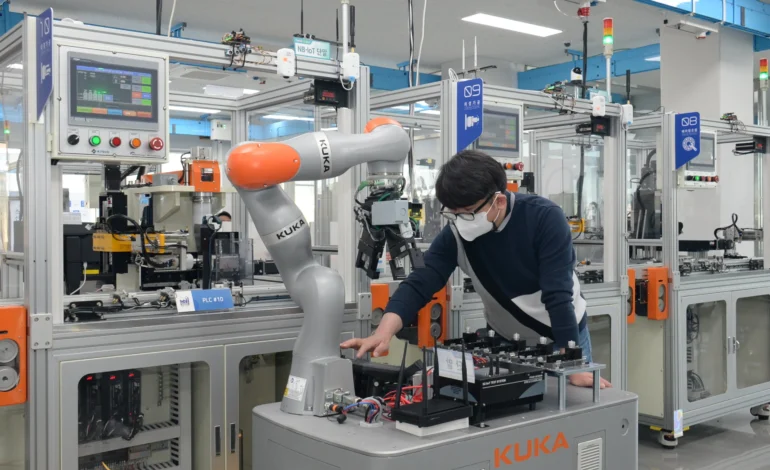
China’s industrial landscape is entering a decisive transformation as AI-driven factories replace traditional assembly lines with data-intelligent production systems.
In regions such as Guangdong, Shenzhen, and Suzhou, entire industrial clusters are shifting toward automation integrated with digital finance and real-time analytics.
According to the Ministry of Industry and Information Technology (MIIT), intelligent manufacturing contributed nearly 36 percent of China’s GDP growth in 2025, underscoring the strategic role of technology in sustaining productivity amid labor shortages and global competition.
From Automation to Intelligence
Unlike earlier mechanization phases, today’s AI factories operate as self-learning environments where robotics, cloud platforms, and sensors collaborate autonomously.
Each production unit collects operational data, shares it with centralized control systems, and adjusts processes using predictive AI models.
This transformation reduces downtime, enhances energy efficiency, and supports continuous quality control.
Factories in Shenzhen’s Bao’an Industrial Zone and Suzhou High-Tech Park already report double-digit efficiency gains since adopting fully networked robotic lines.
The integration of real-time data flows with automated decision systems ensures that machines and humans operate in synchronized harmony.
Workforce Reskilling and Digital Competence
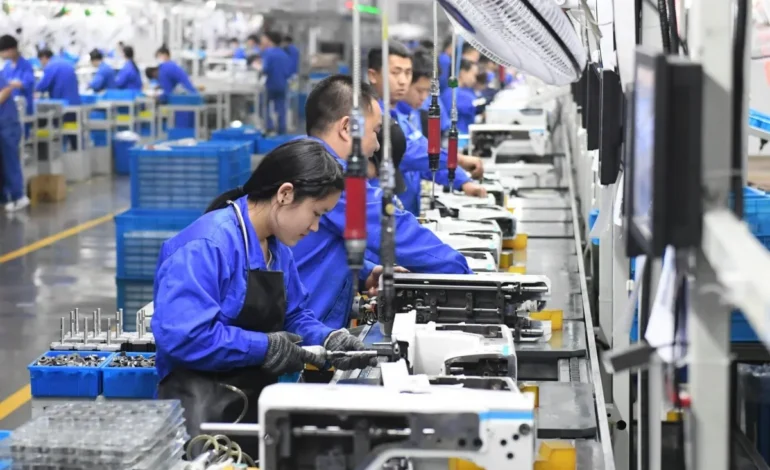
China’s AI factory revolution is as much about people as machines.
Government and industry partners are investing heavily in reskilling programs to prepare workers for high-tech roles.
Technical colleges in Guangdong and Zhejiang have introduced specialized curricula in robot maintenance, data management, and AI logistics analysis.
The transition from manual labor to digital supervision requires new competencies in programming, algorithmic thinking, and human-machine collaboration.
The State Council’s Talent Development Plan 2025 outlines incentives for companies that provide on-site AI training, ensuring that automation enhances human productivity rather than replaces it.
Programmable Finance and Machine-Level Transactions
Inside AI factories, financial systems are becoming as automated as the production lines themselves.
Smart contract mechanisms allow machines to record their operational metrics and trigger automatic payments once specific production goals are met.
For instance, a robotic arm that completes a series of precision tasks can log its performance data onto a secure digital ledger that initiates instant settlement with the equipment provider or maintenance vendor.
This automated micro-transaction model ensures transparency and reduces the administrative burden of industrial finance.
Analysts describe this emerging architecture as programmable industrial finance, where digital verification and financial automation merge to create self-auditing supply chains.
Policy Support and Industrial Coordination
Beijing has made AI factories a central pillar of its 14th Five-Year Plan for Digital Economy Development.
Policy tools such as tax rebates, low-interest loans, and AI innovation grants encourage enterprises to upgrade equipment and integrate data governance standards.
Local governments in Jiangsu and Guangdong are developing industrial data exchanges that enable companies to trade real-time production information securely while maintaining confidentiality.
This institutional support has fostered clusters where robotics manufacturers, software developers, and fintech providers operate within a single digital ecosystem.
The result is a national network of innovation zones where policy and technology reinforce each other to advance manufacturing excellence.
Human-Machine Collaboration and Ethical Governance
As AI becomes embedded in daily operations, questions of safety, privacy, and accountability gain importance.
Enterprises are required to implement AI ethics guidelines mandated by the China Academy of Information and Communications Technology (CAICT), ensuring that decision-making algorithms remain transparent and auditable.
Factories now employ AI supervisors who monitor robotic actions for bias, safety, and efficiency.
This human-machine balance builds public trust and establishes China as a global leader in ethical industrial automation.
Outlook for 2026 and Beyond
China’s AI factories are expected to expand rapidly over the next decade, driving exports of both robotic equipment and automation software.
By 2026, industry analysts predict that nearly half of China’s manufacturing output will be supported by AI-enabled production systems.
The integration of programmable finance and machine-to-machine data transactions will further strengthen the country’s industrial resilience and global competitiveness.
Conclusion
China’s AI factories represent a paradigm shift in industrial organization and workforce design.
Through the fusion of robotics, artificial intelligence, and digital finance, manufacturing is becoming a networked system of autonomous productivity.
By supporting reskilling initiatives and programmable financial governance, China is proving that automation and human capital can advance together.
This transformation marks the foundation of a new industrial era where efficiency, inclusion, and transparency define economic progress.