
China’s J-16 “Hidden Dragon” Gains Renewed Attention After Reported Encounter with Foreign Jets
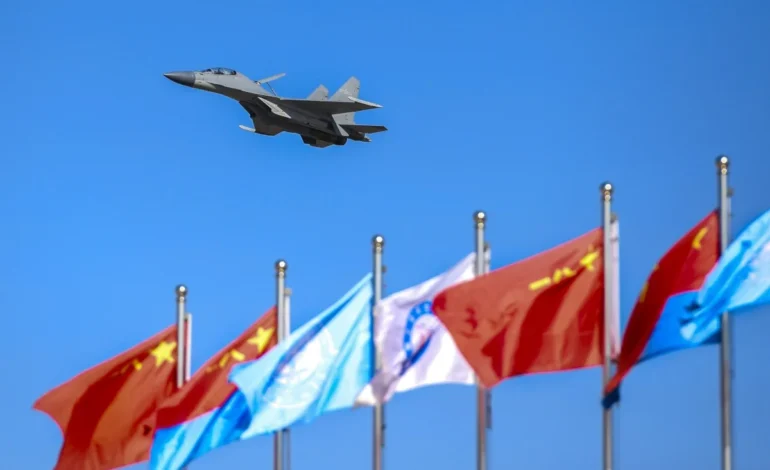
China’s J-16 fighter jet, known domestically as the “Hidden Dragon,” has returned to global headlines after reports that the aircraft intercepted and chased off two foreign fighters near China’s air-defence identification zone earlier this month.
The incident, first noted by regional defence observers, underscores the aircraft’s growing role within the People’s Liberation Army Air Force (PLAAF) as part of its evolving “door-kicking combination,” a coordinated formation integrating electronic warfare, stealth, and precision-strike aircraft.
Operational maturity and tactical balance
The J-16, developed by the Shenyang Aircraft Corporation, is a twin-seat, twin-engine multirole fighter designed for both long-range air-superiority and ground-attack missions. Built on advanced composite materials and equipped with a new generation of active electronically scanned array (AESA) radar, the jet has become a mainstay of China’s front-line air units.
Analysts in Beijing note that the recent encounter highlights the J-16’s operational readiness and the shift toward network-centric combat, where aircraft share targeting and reconnaissance data in real time. Although newer models such as the stealth J-20 and carrier-borne J-35 attract more public attention, the J-16 remains a vital link connecting older fourth-generation fleets with next-generation systems.
The “door-kicking” combat model
Chinese military commentators describe the “door-kicking” doctrine as a layered strike concept: stealth fighters such as the J-20 open contested airspace by neutralising enemy sensors, while multirole aircraft like the J-16 deliver precision firepower to secure control of the skies.
The doctrine reflects China’s broader effort to modernise its air command structure and integrate air-to-surface, cyber, and electronic operations under unified command.
According to analysts at the China Air and Space Studies Institute, this approach allows the PLAAF to project deterrence at greater ranges while maintaining strategic restraint.
Equipment upgrades and production capacity
Recent state media coverage has shown upgraded J-16 variants equipped with domestically produced WS-10 C engines, improved avionics, and enhanced electronic-warfare pods.
These advances have increased flight endurance and reduced maintenance cycles, enabling continuous patrols over maritime approaches in the East and South China Seas.
Sources close to the defence industry said mass-production lines in Shenyang have accelerated deliveries since mid-2024 to support China’s push for comprehensive combat readiness under the 14th Five-Year Plan for national defence science and technology.
Strategic messaging and regional perception
The reported aerial encounter occurred amid intensified foreign surveillance activities near China’s coastline. Military analysts interpret the event as a controlled demonstration of deterrence, showing China’s capacity to defend its airspace without escalating tensions.
Beijing has repeatedly stated that all interception operations are conducted in accordance with international law and flight safety norms.
For the PLAAF, the J-16 exemplifies the balance between capability and discipline, a platform powerful enough to enforce sovereignty yet designed to operate within strategic thresholds set by national policy.



