
China’s Manufacturing PMI Improves After Six-Month Contraction
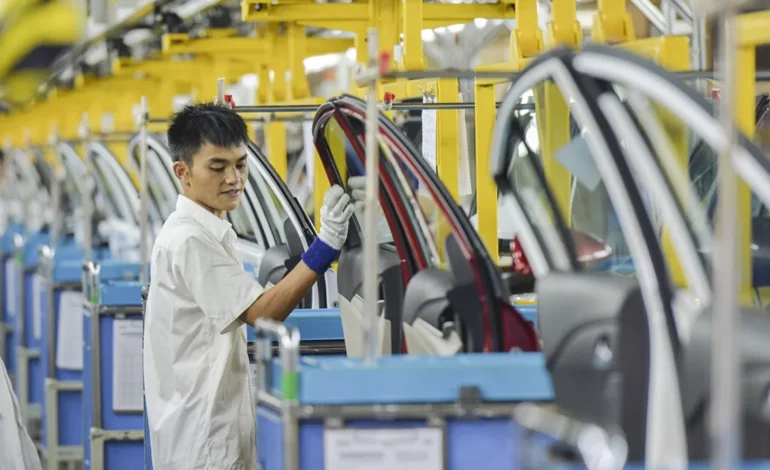
China’s manufacturing sector recorded its first expansion in six months, signaling a modest but notable recovery in industrial momentum. According to data from the National Bureau of Statistics (NBS), the official Purchasing Managers’ Index (PMI) rose to 50.2 in October, up from 49.6 in September. Any reading above 50 indicates expansion.
Analysts say the rebound reflects stronger export orders, easing supply-chain constraints, and renewed domestic demand supported by fiscal and credit measures. Economists, however, caution that structural challenges persist as global demand remains fragile.
Manufacturing Sector Shows Signs of Stabilization
The NBS report highlighted gains across key sub-indices including production, new orders, and raw material purchases. Production rose to 51.6, while new export orders reached their highest level since early 2024, suggesting stabilization in external trade conditions.
Manufacturers surveyed by Caixin reported a steady increase in client inquiries and factory output, especially in electronics, machinery, and auto components. The private Caixin PMI also climbed to 50.8, marking its strongest performance since April.
Industrial zones in Jiangsu and Zhejiang provinces showed a pickup in activity, supported by local stimulus policies and subsidies for small and medium enterprises. Supply bottlenecks have eased as logistics and transport costs normalized following months of tight shipping conditions.
“The latest PMI reading suggests that China’s manufacturing cycle has passed its weakest point,” said Liu Xinyu, senior economist at Haitong Securities. “Although the recovery remains uneven, the rebound in production and new orders points to improving business sentiment.”
Policy Support and Export Resilience
The manufacturing uptick comes as Beijing increases fiscal support for industrial upgrades and export competitiveness. The Ministry of Commerce recently launched a new package of incentives for export-oriented firms, including tax credits for high-value-added goods and logistical subsidies for priority industries such as semiconductors, green vehicles, and energy equipment.
Meanwhile, the People’s Bank of China (PBoC) has continued to inject liquidity into the manufacturing sector through targeted re-lending programs. These measures aim to reduce borrowing costs for small manufacturers and accelerate adoption of digital and automated production lines.
Export performance improved slightly as shipments to Southeast Asia and the Middle East rose, offsetting declines in orders from the U.S. and Europe. Analysts note that resilient demand for low-cost electronics, auto parts, and renewable energy equipment continues to underpin China’s export base.
“The export recovery may be gradual, but the structural shift toward emerging markets is cushioning China from external shocks,” said economist Zhang Tao at the IMF’s Asia-Pacific division.
Industrial and Domestic Challenges
Despite improving data, factory managers remain cautious about profit margins, citing rising input costs and subdued consumer demand at home. The prices of raw materials such as copper and steel have increased due to supply constraints, putting pressure on smaller manufacturers.
Nikkei Asia reported that many factories are diversifying production to include AI-driven automation and green technologies in line with national industrial policy goals. This transformation, though positive, requires significant investment and may slow short-term profitability.
Industrial economists emphasize that maintaining steady credit flow and ensuring local government support will be crucial for sustaining the recovery. The government’s plan to expand its industrial modernization fund to 1.2 trillion yuan in 2026 is expected to further boost innovation and productivity.
Gradual Recovery Expected Through 2026
Analysts forecast a continued rebound in manufacturing activity through early 2026, supported by policy easing, improved export demand, and renewed infrastructure investment. However, they caution that slower global growth and weak property-linked industries could limit momentum.
Economists from Caixin suggest that sustained PMI readings above 50 over the next two quarters would confirm a broader industrial recovery and signal renewed confidence in China’s post-pandemic manufacturing transformation.



