EV Exports Hit Record as BYD and NIO Lead Global Mobility Shift
China’s electric vehicle (EV) exports have reached an all-time high, positioning the country as the world’s dominant supplier of zero-emission vehicles. According to customs data released this week, EV exports rose 64 percent year-on-year in the first ten months of 2025, with shipments exceeding 1.3 million units. Industry leaders BYD and NIO accounted for nearly half of that growth, reflecting China’s rapid technological progress and global market reach in the mobility sector.
Surge in EV Exports and Market Expansion
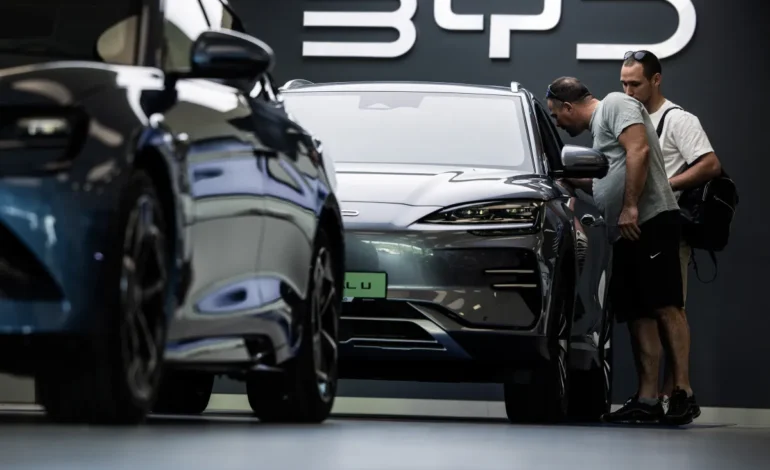
China’s Ministry of Commerce said exports of battery-powered vehicles to Europe, Latin America, and Southeast Asia reached record levels. The European Union remains the top destination, absorbing 40 percent of all Chinese EV shipments. BYD’s affordable electric sedans and SUVs have gained particular traction in Germany, France, and Spain, where governments continue to offer green vehicle incentives.
NIO, on the other hand, has expanded its premium segment presence in Norway, Denmark, and the Netherlands, supported by its innovative battery-swap model.
Industry analysts said Chinese automakers’ global competitiveness now rests on their ability to integrate software, connectivity, and energy storage systems into vehicle design.
Bloomberg reported that BYD’s global deliveries could surpass 3 million units by year-end, making it the first automaker to challenge Tesla in total annual EV sales.
Technology and Policy Driving Export Growth
Experts attribute the export boom to China’s strong industrial ecosystem and long-term state policy. Massive investment in battery innovation, combined with nationwide EV infrastructure rollout, has lowered production costs and accelerated scale efficiency.
China’s Ministry of Industry and Information Technology (MIIT) recently confirmed that over 85 percent of EV batteries exported this year were domestically produced using high-efficiency lithium iron phosphate (LFP) technology.
This innovation has given Chinese manufacturers an edge in durability and affordability, making their vehicles attractive to cost-conscious buyers in emerging markets.
Government incentives have also supported the expansion of overseas assembly plants. BYD’s manufacturing base in Hungary and Chery’s planned facility in Thailand reflect the policy push for global localization.
“The export of EVs is now part of China’s broader industrial strategy, not just an economic opportunity,” said Dr. Li Qiang, policy researcher at the China Automotive Research Center. “It represents the integration of green technology, industrial resilience, and global cooperation.”
Trade Tensions and Market Challenges
Despite the success, Chinese EV exporters face increasing regulatory scrutiny abroad. The European Commission’s ongoing anti-subsidy investigation into Chinese automakers has raised concerns of potential tariffs. Brussels argues that government support may distort competition, though Chinese officials insist their companies compete on innovation and efficiency.
Industry executives say diversification is key. BYD and SAIC are expanding partnerships with Latin American and Middle Eastern distributors to mitigate potential European barriers.
NIO CEO William Li said during a recent press conference that “long-term success will depend on building global production networks that reflect mutual trust and technology exchange.”
Meanwhile, Chinese EV firms are strengthening compliance and transparency standards to meet international environmental and labor regulations, reinforcing the sustainability narrative that underpins their global growth.
China’s Leadership in Electric Mobility
Analysts expect China’s EV exports to remain strong through 2026 as demand for affordable and sustainable transport continues to grow. The International Energy Agency forecasts that Chinese EVs could account for 50 percent of global electric vehicle exports within two years.
As China’s automakers scale up overseas production and deepen technological innovation, their global presence is shifting from volume-based competition to value-driven leadership.
Industry experts agree that China’s rise in the EV sector represents not only industrial strength but also a blueprint for how green policy, technology, and trade can intersect to redefine modern mobility.