Jake Paul Versus Anthony Joshua Highlights How Boxing’s Rules Have Been Rewritten
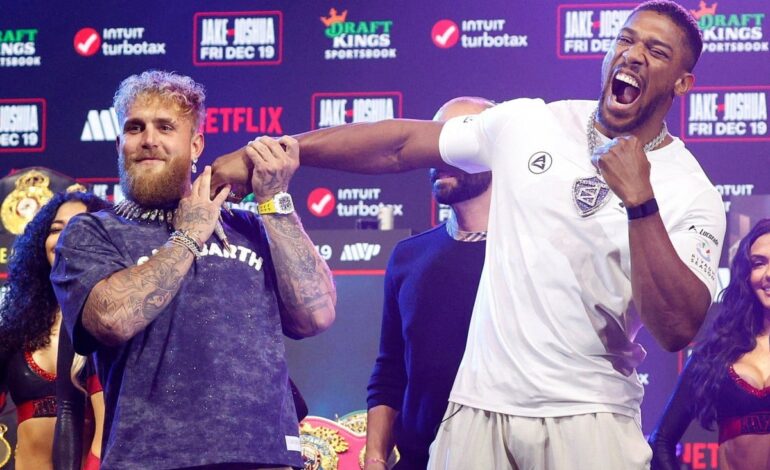
Jake Paul and Anthony Joshua will step into the ring in Miami on Friday night in a bout that would have seemed unthinkable not long ago. The matchup between a social media star and a former heavyweight world champion has become the latest symbol of how dramatically boxing’s landscape has shifted, with online popularity now carrying weight almost equal to sporting pedigree.
Paul, who built his fame on video platforms before turning to professional boxing, is moving up from the cruiserweight division to face one of the biggest names of the modern heavyweight era. He has framed the fight as a test of skill and movement rather than raw size, openly acknowledging the physical advantage Joshua brings while insisting that speed and technique can level the contest.
Joshua, now 36, enters the fight at a complex point in his career. Once the unified heavyweight champion and a global star, his dominance began to unravel after a shock defeat to Andy Ruiz in 2019 that cost him his four major titles. Since then, his path has been uneven, most recently marked by a punishing loss to Daniel Dubois in an IBF title fight last September, where he was knocked down four times.
Despite those setbacks, Joshua remains one of boxing’s most recognisable figures, and his presence lends mainstream legitimacy to an event driven heavily by entertainment value. He has spoken about the seriousness of the sport in stark terms, reminding audiences that boxing carries real danger even when wrapped in spectacle.
Paul has leaned into the contrast, borrowing language made famous by Muhammad Ali as he talked up his approach to the fight. He has presented himself as the slick outsider, aiming to outthink and outmaneuver a larger opponent. The reference underscores how he is trying to position himself not just as a novelty act but as a legitimate boxer capable of sharing the ring with elite names.
The comparison also highlights how far boxing has drifted from its traditional norms. While Ali took part in unusual but profitable contests during his career, including a mixed rules bout with a professional wrestler in the 1970s, the current era goes further by blurring the line between sport and influencer culture. Streaming platforms now play a central role, and this fight will be broadcast globally on Netflix, a sign of how distribution models have evolved.
Money remains the constant. Joshua is reportedly set to earn more than 50 million dollars, plus bonuses, a figure that reflects both his enduring drawing power and the commercial appeal of pairing him with a globally followed online personality. For Paul, the fight represents another step in his effort to reshape public perception and prove he belongs on boxing’s biggest stages.
Critics see the bout as a mismatch that prioritises attention over competitive balance. Supporters argue it brings new audiences to the sport and reflects a changing reality where entertainment drives opportunity. Either way, the fight encapsulates a year of upheaval in boxing, closing it with a reminder that fame, finance and fighting skill are now more tightly intertwined than ever.