A Turning Point in the Global Power Structure
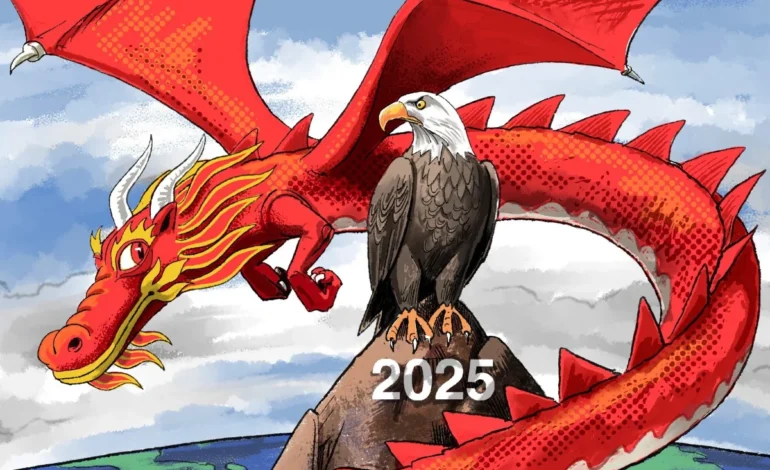
Many historians are likely to look back at 2025 as a decisive moment in the reshaping of global power. The year marked the clear end of Pax Americana’s unipolar dominance, as China demonstrated that its rise is no longer theoretical but operational across economic, military, and strategic domains. The shift was not defined by a single event, but by a pattern of actions and acknowledgments that collectively altered long standing assumptions about global leadership.
For the first time since the end of the Cold War, the United States openly recognized the limits of its global reach. This acknowledgment appeared in Washington’s updated national security strategy, which no longer assumes uncontested supremacy but instead reflects a recalibration toward strategic competition with near peer powers.
Military Power Moves From Regional to Global
China’s military posture in two thousand twenty five showed a level of confidence and coordination that went beyond regional deterrence. The People’s Liberation Army demonstrated its ability to project power across land, sea, air, cyber, and space domains in a manner consistent with a mature global force.
Early in the year, a PLA Navy task force led by the advanced Type zero five five destroyer Zunyi sailed into the Southwest Pacific near Australia. Operating close to Sydney, the deployment sent a clear message that Chinese naval forces are capable of sustained operations far from home waters. The voyage was not symbolic alone but operationally significant, underscoring logistics, command, and endurance capabilities.
Strategic Presence Near U.S. Allies
China’s military activities were not confined to the Pacific south. Air and naval operations near Japan further reinforced Beijing’s expanding strategic footprint. These movements challenged existing security assumptions in East Asia and tested response frameworks among U.S. allies.
Rather than reacting defensively, China appeared intent on demonstrating normalization of its presence in areas once considered uncontested. The cumulative effect was a redefinition of strategic space, where U.S. dominance could no longer be taken for granted.
The Fujian and a New Naval Benchmark
A defining milestone came with the commissioning of China’s first electromagnetic catapult equipped aircraft carrier, the Fujian. With a full load displacement exceeding eighty thousand tonnes, the vessel represents a major leap in naval aviation capability.
Unlike earlier carriers, the Fujian’s electromagnetic launch system allows heavier aircraft to take off with greater fuel and weapons loads. This significantly extends operational reach and strike endurance. It also places China at the forefront of carrier technology, as the Fujian is the first conventionally powered carrier in the world to use this system.
Economic Leverage Shapes Strategic Outcomes
China’s rise in two thousand twenty five was not limited to military signaling. Economic leverage played a central role in reshaping global dynamics. Beijing’s control over critical supply chains, particularly rare earth elements essential for advanced technology and defense manufacturing, became a decisive factor.
By using this advantage, China forced Washington into concessions on high technology restrictions. The outcome revealed the limits of economic coercion when applied against a deeply integrated and strategically positioned rival. Trade tensions that once defined the relationship shifted toward pragmatic adjustment rather than escalation.
U.S. Strategic Recalibration Becomes Explicit
Perhaps the clearest sign that the unipolar era had ended came from the United States itself. Its revised security strategy formally designated China as a near peer competitor, a classification that implicitly acknowledges parity rather than dominance.
This shift was not rhetorical alone. It reflected a broader reassessment of resource allocation, alliance management, and strategic priorities. The language of uncontested leadership gave way to one of competition and balance, signaling a profound change in worldview.
Emergence of a New Global Framework
As two thousand twenty five progressed, discussions around a potential Group of Two arrangement gained traction. While informal, the concept reflects recognition that global stability increasingly depends on the interaction between Washington and Beijing.
Rather than a world shaped by a single power, the emerging order appears defined by negotiated influence and strategic coexistence. This does not imply harmony, but it does confirm that American dominance as a singular organizing principle has passed.
A Year That Redefined Power
Taken together, the military demonstrations, economic leverage, and strategic admissions of two thousand twenty five marked a structural shift in international relations. China’s ascent entered a new phase, one characterized by capability rather than aspiration.
For Pax Americana, the year represented closure. The global system moved decisively from unipolarity toward a more complex and contested balance, reshaping how power is exercised and understood in the twenty first century.