Why Myanmar’s Junta Election Fails to Conceal a Rapidly Collapsing Economy
Myanmar’s military leaders have begun a phased election process that they say will restore order and legitimacy, but economists and regional analysts argue the vote cannot disguise the country’s worsening economic collapse. With inflation among the highest in Asia, widespread power shortages and a civil war that continues to drain resources, the election is widely viewed as a political exercise rather than a solution to deepening structural damage.
Voting began in selected areas on Sunday, with additional rounds planned for January. Critics say the staggered approach is designed to project control over limited territories rather than demonstrate national stability. Large parts of the country remain inaccessible or insecure, and millions of people displaced by fighting are effectively excluded from the process.
Much of Myanmar’s economic decline can be traced back to the pandemic, which disrupted trade, tourism and manufacturing. The situation deteriorated sharply after the 2021 military takeover, which triggered mass protests, international sanctions and an expanding armed resistance. Since then, economic activity has been steadily eroded by insecurity, capital flight and the collapse of investor confidence.
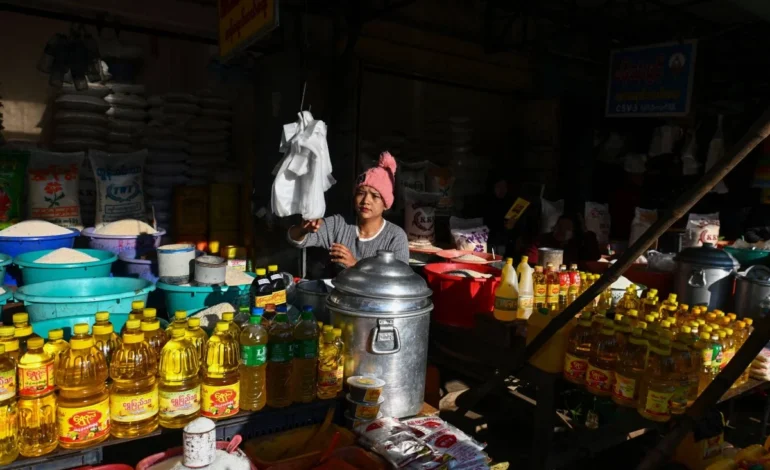
Inflation has surged as the national currency weakened and supply chains fractured. Prices of basic goods have risen sharply, placing severe pressure on household incomes. At the same time, power shortages have become routine, forcing factories and small businesses to operate at reduced capacity or shut down altogether. Analysts say these conditions make sustained recovery nearly impossible regardless of political messaging.
To keep the state functioning, the military authorities have increasingly relied on short term and opaque revenue sources. These include the rapid extraction and sale of rare earth minerals, often with limited environmental oversight, as well as revenue linked to illicit activities such as narcotics trafficking and online scam networks. Experts warn that such measures may provide immediate cash but further entrench corruption and undermine long term development.
The election itself is unlikely to reassure businesses or foreign partners. International observers have raised concerns about the absence of key opposition figures and the lack of independent oversight. Without broad participation and credibility, the vote is seen as reinforcing isolation rather than reopening economic channels.
Analysts also point to the heavy burden of ongoing conflict. Military spending remains high, diverting resources away from health care, education and infrastructure. At the same time, fighting disrupts agriculture and trade routes, further reducing output in rural areas that once formed the backbone of the economy.
For ordinary citizens, the impact is immediate and personal. Rising living costs, job losses and unreliable electricity have become part of daily life. Many skilled workers have left the country, accelerating a brain drain that further weakens prospects for recovery.
The leadership of Myanmar has framed the election as a step toward stability, but economists argue that political theatre cannot compensate for collapsing fundamentals. Without an end to conflict, credible governance and re engagement with international partners, the country’s economic freefall is likely to continue, regardless of how many ballots are cast.