PLA Conducts Taiwan Drills as China Expands Record Scale Air Power Capabilities
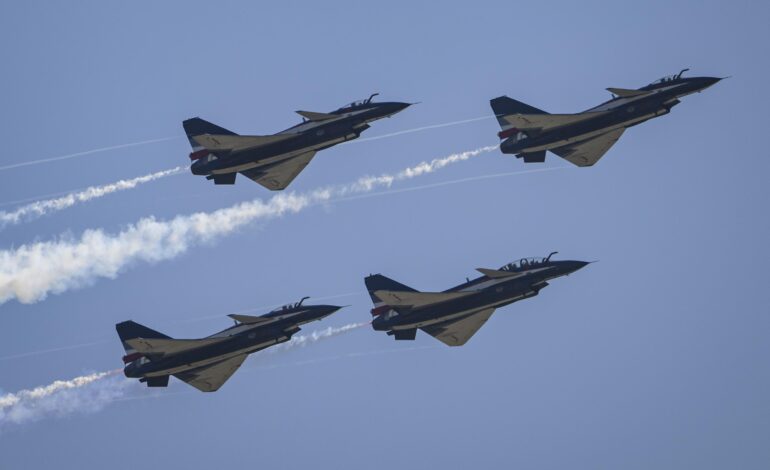
China’s military has carried out new drills around Taiwan while simultaneously expanding what analysts describe as a record scale airborne force posture, underscoring Beijing’s growing emphasis on sustained air power and rapid response capability in a potential cross strait crisis.
The exercises, conducted by the People’s Liberation Army, involved coordinated air and naval movements near Taiwan, according to official Chinese statements and regional military monitoring. Aircraft were seen operating in multiple directions around the island, a pattern that defence observers say is intended to simulate encirclement scenarios and test Taiwan’s response readiness under sustained pressure.
Chinese military officials said the drills were aimed at improving joint combat capabilities and safeguarding national sovereignty. While Beijing regularly frames such exercises as routine, the timing and scale have drawn attention as tensions remain elevated over Taiwan’s political future and its security ties with the United States and regional partners.
Alongside the drills, China has continued to strengthen what some analysts have labelled an “air battery,” referring to the rapid expansion of air assets that can be deployed, rotated and sustained over long periods. This includes fighter jets, bombers, airborne early warning aircraft and support planes operating as an integrated system rather than isolated units.
Military experts say the concept mirrors a layered approach similar to missile batteries, but in the air. By maintaining a large and flexible pool of aircraft that can be launched in waves, the PLA aims to exhaust adversary defences while maintaining operational tempo. The approach relies heavily on logistics, command systems and pilot training, areas where China has invested heavily over the past decade.
The drills were carried out by units under the People’s Liberation Army, including its air force, which has undergone rapid modernisation. Newer aircraft types and upgraded systems have allowed longer patrols and more complex flight patterns, increasing pressure on Taiwan’s air defence resources.
Taiwan’s defence ministry said it monitored the movements closely and scrambled aircraft as needed, while activating missile and radar systems. Officials in Taipei have repeatedly warned that frequent PLA operations raise the risk of miscalculation, particularly as both sides operate in close proximity.
Regional analysts note that the expanded air posture is not only directed at Taiwan but also serves a broader strategic purpose. It demonstrates China’s ability to project power across the western Pacific and complicates planning for external forces that might intervene in a conflict. Sustained air operations could play a key role in enforcing blockades, supporting amphibious forces or deterring outside involvement.
Beijing continues to insist that Taiwan is an internal matter. The Chinese government has criticised foreign military cooperation with Taipei, arguing that it encourages separatist sentiment. At the same time, Chinese officials say military pressure is necessary to counter what they describe as provocations by Taiwan’s leadership.
The drills come amid a wider pattern of increased PLA activity in the Taiwan Strait and surrounding waters. In recent years, exercises have become more frequent, larger in scale and more realistic, reflecting lessons drawn from modern conflicts and advances in surveillance technology.
While no immediate escalation has followed the latest drills, defence experts say the combination of regular exercises and expanding air capabilities signals a long term shift rather than a short term message. For Taiwan and its partners, this means preparing not just for isolated incidents, but for sustained military pressure that could be applied over extended periods.
As military activity continues, diplomats in the region have renewed calls for restraint and communication mechanisms to prevent accidents. Despite this, the underlying strategic competition shows little sign of easing, with air power playing an increasingly central role in shaping the balance across the Taiwan Strait.