AI-Driven Factories: How Automation is Powering China’s Made-in-China 2025 Vision
China’s manufacturing sector is experiencing one of the most profound transformations in its modern history. The government’s Made-in-China 2025 strategy aims to elevate the nation from a low-cost production hub to a global leader in high-tech manufacturing. At the center of this transition lies artificial intelligence (AI) and automation.
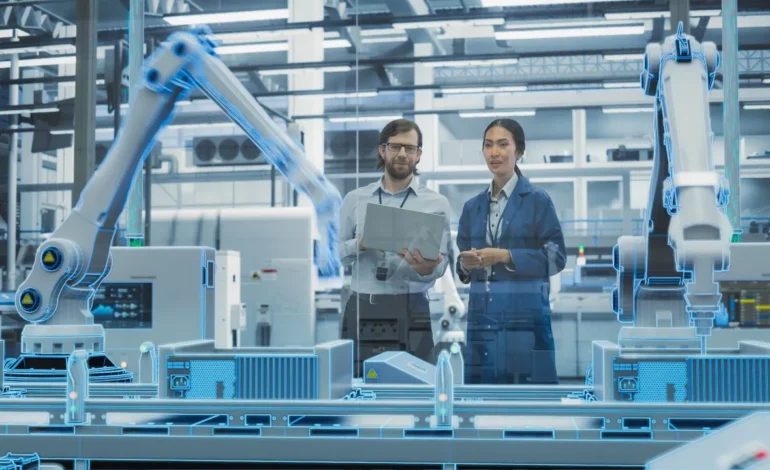
Across industrial hubs such as Shenzhen, Suzhou, and Chongqing, factories are replacing manual labor with intelligent systems that can learn, adapt, and optimize production in real time. Reports from China Daily, Global Times, and South China Morning Post indicate that more than 80 percent of large manufacturers in China now use AI-based automation. The results include higher productivity, reduced energy consumption, and greater precision.
The Smart Factory Revolution
Modern Chinese factories merge digital and physical systems to create cyber-physical production lines. They use AI, IoT, and data analytics to coordinate every step from design to delivery. A leading case is Haier’s COSMOPlat in Qingdao, where customers personalize orders online and robotic systems automatically adjust production. Efficiency has improved by 25 percent and waste has dropped by nearly 30 percent. In Suzhou, Huawei’s FusionPlant connects machines and logistics vehicles through an AI data loop that reduces downtime and boosts yield. CATL and BYD are applying similar models in batteries and electric vehicles, making automation the new industrial standard in China.
How AI Shapes the Future of Manufacturing
AI turns factory data into decisions that improve speed, safety, and quality. At Foxconn’s Shenzhen site, algorithms monitor over 20,000 robotic arms and predict maintenance needs before failures occur. CRRC’s railway plants use computer vision to detect micro-defects that humans miss, ensuring flawless welding. In Zhejiang’s textile mills, AI cameras find weaving errors instantly, cutting waste. Paired with 5G networks, these systems enable real-time coordination across multiple factories. The result is higher precision, lower costs, and continuous learning that keeps production adaptive and competitive.
Policy and the National Push for Smart Industry
China’s 14th Five-Year Plan lists intelligent manufacturing as a national priority. The Ministry of Industry and Information Technology (MIIT) has created more than 400 smart-factory demonstration zones. Provincial governments in Guangdong and Jiangsu are offering large subsidies for AI upgrades. Programs such as Industrial Internet Plus connect small manufacturers to cloud-based AI tools. A furniture maker in Foshan, for example, uses Alibaba Cloud’s industrial AI to model designs, forecast material needs, and cut production costs by about 20 percent. These initiatives make advanced automation accessible beyond China’s tech giants.
The Human Role in Automated Production
Automation in China is redefining, not removing, factory jobs. Workers are moving into new roles such as robot maintenance, data analytics, and digital supervision. In Chongqing, a Smart Factory Training Center run by Huawei and Siemens retrains 100,000 people each year in robotics and AI operations. At BYD’s EV facility, collaborative robots perform repetitive assembly while technicians handle quality control. This human-machine cooperation improves safety and efficiency, showing that technological progress can create better employment rather than replace it.
Sustainability and Green Manufacturing
AI is also helping China meet its carbon-neutral goals. Smart factories use algorithms to schedule operations efficiently, reducing idle time and energy consumption by as much as 15 percent. At Tesla’s Gigafactory Shanghai, an AI system regulates welding, lighting, and climate to save millions of kilowatt-hours annually. Emission sensors feed real-time data into China’s national carbon-trading platform, ensuring transparency and compliance. Green automation is now part of the country’s industrial identity, linking innovation with environmental responsibility.
Challenges and the Road Ahead
Small and medium manufacturers still struggle to adopt AI due to cost and fragmented software systems. The government is promoting open-source industrial standards to ensure compatibility between different robotics and AI platforms. Domestic suppliers such as Estun, Inovance, and Hikvision Robotics are rapidly building local capacity in sensors and control chips to reduce import dependence. Analysts predict that by 2030, nearly all major Chinese factories will run on smart systems, marking China’s transition from the world’s factory to the world’s innovation engine.
Conclusion
AI-driven automation is the backbone of China’s new manufacturing era. It merges data, robotics, and sustainability into a single intelligent ecosystem. Through coordinated policy, industry innovation, and workforce transformation, the Made-in-China 2025 vision is moving from blueprint to reality. In factories across the country, humans and machines now work together, powering a future where efficiency, intelligence, and green production define global industry leadership.