Ancient Fossil Discovery Reveals Cross-Equator Migration Route in Supercontinent Pangaea
A fossil find with global significance
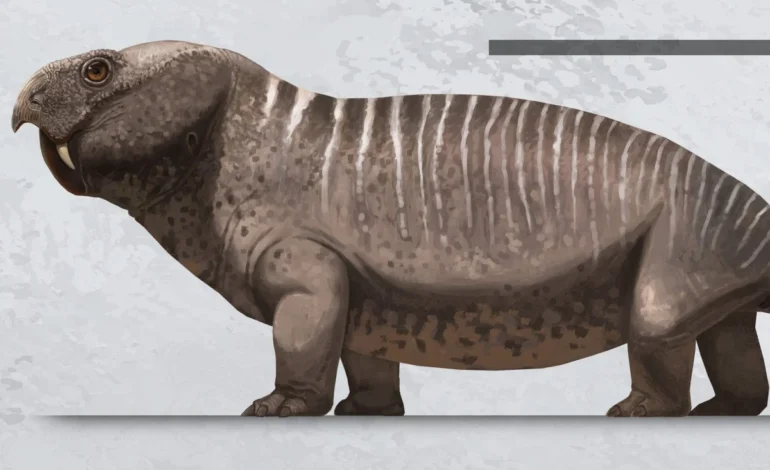
A newly identified fossil from China is reshaping scientists’ understanding of how large animals moved across the ancient Earth more than 250 million years ago. The remains belong to a previously unknown species of dicynodont, a group of herbivorous, mammal-like reptiles that lived before the age of dinosaurs. What makes the discovery remarkable is not just the age of the fossil, but what it suggests about prehistoric migration. Researchers say the find provides compelling evidence that large land animals once traveled across vast distances, including routes that crossed the equator, when Earth’s continents were joined together in the supercontinent Pangaea.
Linking distant regions through deep time
The fossil was uncovered in what is now China, yet its closest known relatives have been found thousands of kilometers away in South Africa. This unexpected connection suggests that dicynodonts were capable of migrating across enormous landmasses that once spanned the globe. During the late Permian period, when these animals lived, today’s continents were fused into a single supercontinent, eliminating oceans that now act as natural barriers. The new species helps bridge a geographic gap in the fossil record that had long puzzled paleontologists.
Evidence for a cross-equator migration corridor
Scientists believe the discovery points to the existence of a cross-equator migration corridor that allowed large animals to move between what are now northern and southern hemispheres. Such movement would have required relatively stable climates and accessible terrain across equatorial regions. Previously, researchers debated whether extreme heat or environmental barriers near the equator would have limited large animal movement. The new fossil evidence suggests those barriers were not as restrictive as once thought, opening the possibility that prehistoric ecosystems were more interconnected than previously assumed.
Climate and environment of ancient Earth
During the late Permian period, Earth’s climate differed significantly from today’s. While the equator was warmer, it may not have been uniformly hostile to large herbivores. Seasonal rainfall patterns, vegetation belts, and river systems could have supported long distance migration. Dicynodonts, with their robust bodies and efficient feeding strategies, were well suited to such journeys. The new species adds weight to the idea that these animals were highly adaptable and capable of thriving across a wide range of environments.
Implications for evolution and extinction studies
Understanding how animals moved across Pangaea has broader implications for studying evolution and extinction. Widespread migration would have facilitated gene flow between populations, influencing how species evolved over time. It also helps explain why similar animal groups appear in fossil records across distant continents. This interconnectedness becomes especially important when examining the end Permian mass extinction, the most severe extinction event in Earth’s history. Migration routes may have shaped which species survived and how ecosystems recovered afterward.
Filling gaps in the fossil record
The fossil record is inherently incomplete, often shaped by chance discoveries rather than continuous evidence. Finds like this new dicynodont species help fill critical gaps, allowing scientists to test long standing theories with tangible data. By linking fossils from China and South Africa, researchers can now construct more accurate models of ancient biodiversity and movement patterns. Each new discovery refines the picture of how life functioned on a planet very different from today’s world.
A reminder of Earth’s deep connectivity
Beyond its scientific detail, the discovery offers a powerful reminder of Earth’s deep past connectivity. Long before modern borders and oceans, animals roamed freely across a single massive landmass. The newly identified fossil stands as evidence that ancient life was dynamic, mobile, and globally linked. As researchers continue to uncover fossils in understudied regions, more surprises are likely to emerge, further revealing how interconnected life on Earth has always been.