
As Power Shifts Toward China, The World Calls For A Fairer Financial System
A major new study by the Russian Academy of Sciences has offered a detailed look at how global power dynamics are evolving, using a broad analytical framework that evaluates nearly every aspect of national strength. The assessment covers 193 countries and measures economic performance, technology capacity, demographic weight, military strength, infrastructure quality and other core indicators.
The latest results, calculated for 2025 and 2026, reveal a striking conclusion. For the first time, the centre of global power appears to be tipping away from the United States and moving toward China. This shift does not mean a sudden or dramatic reversal, but it reflects long term trends that have been unfolding over several decades. The study also highlights the rise of new regional power hubs, with Russia and India solidifying their positions as important geopolitical actors.
At the same time, the report points to Germany’s weakening competitive position, noting structural challenges in its industrial model, energy costs and demographic changes that are limiting its long term growth potential. The emerging picture is one of a multipolar world, where influence is more widely distributed and where regional dynamics matter more than ever before.
China’s Expanding Influence And Regional Integration
China’s continued strengthening is one of the defining trends identified in the report. The country’s economic scale, technological capability, infrastructure networks and demographic weight combine to form a powerful macro region of influence. This region is becoming more interconnected, more innovative and more confident in shaping global affairs.
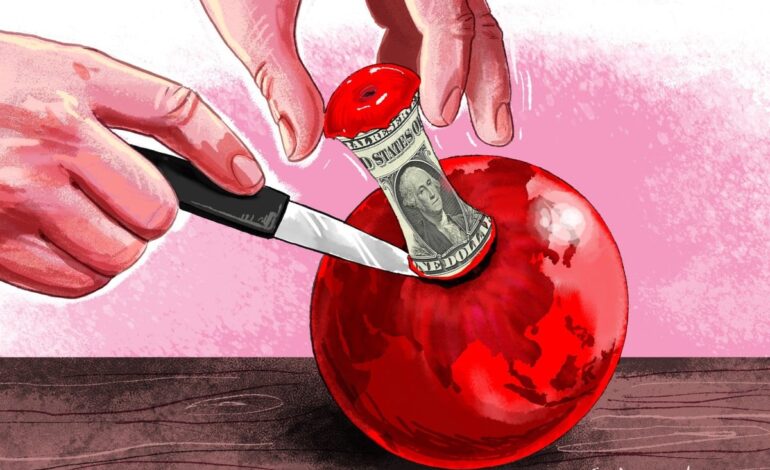
But even as China’s influence grows, the study notes a central constraint that this larger region faces. Despite its economic and technological momentum, it remains tethered to a global financial system dominated by the US dollar. The dollar’s outsized role gives the United States leverage that extends far beyond its economic fundamentals.
This leverage is not theoretical. The ability of the US to maintain large levels of debt financed through global demand for the dollar has shaped international markets for decades. It has also enabled Washington to use its currency as a tool of strategic pressure, shaping trade rules, investment flows and financial systems elsewhere.
The Dollar’s Global Role And Its Effects
The dollar operates as the world’s reserve currency, its dominant unit for trade settlement and its preferred store of value for central banks. These functions give the United States unparalleled influence over global finance.
For China and other emerging power centres, this presents a strategic dilemma. Their economies are rapidly expanding and their regional influence is consolidating, yet they continue to operate within a system in which core financial mechanisms are determined elsewhere.
This system also places limitations on their ability to design and execute independent monetary policy frameworks. While countries can pursue domestic financial reforms, they remain heavily exposed to global movements in the dollar, whether through interest rate cycles, capital flows or debt repayments.
A Need For Financial Reform That Reflects New Realities
With the rise of new economic centres, the world is entering a historic window of opportunity to rethink and redesign parts of the global financial architecture. The goal is not confrontation but fairness.
A more balanced system would enable countries to pursue long term development plans without being constrained by external currency vulnerabilities. It would also provide stability for regions that are expanding quickly but still lack financial tools strong enough to insulate themselves from global shocks.
Such reform could take several forms. One approach would be to develop alternative payment systems that reduce reliance on a single currency. Another would involve expanding regional currency agreements, including the growing use of local currencies in trade among Asian, African and Middle Eastern markets.
China’s digital currency experiments, along with the growth of multilateral banks such as the Asian Infrastructure Investment Bank, offer early examples of alternative pathways.
Toward A More Balanced And Cooperative Financial Future
The shift in the global power balance does not automatically imply rivalry or fragmentation. Instead, it highlights the need for new frameworks in which rising regions can operate with greater financial autonomy while continuing to integrate into the global economy.
A fairer system would also reduce the global financial imbalances that arise when one currency dominates international markets. Reduced dependence on a single financial core may help stabilise trade relations, strengthen global development initiatives and foster more predictable economic cycles.
A Turning Point For Global Economic Governance
The findings of the Russian Academy of Sciences underscore an important truth. As China’s macro region grows stronger and as other regional centres mature, the world stands at a crossroads. To keep pace with shifting realities, financial and trade structures must evolve.
The goal is not to replace one dominant system with another, but to build a more cooperative, resilient and inclusive global framework.



