Audi Targets Profit Recovery in 2026 as Tariff Pressures and China Competition Persist
Audi has outlined expectations for a rebound in profitability in 2026 as it attempts to recover from the financial impact of global tariffs and shifting demand across key markets. The German premium carmaker is forecasting an operating margin between 6 percent and 8 percent this year, following a drop to 5.1 percent in 2025. The outlook reflects cautious optimism as the company balances cost discipline with ongoing external pressures, including geopolitical tensions and evolving trade policies that continue to shape the global automotive industry.
The company’s earnings were significantly affected last year, with tariff related costs estimated at around 1.2 billion euros. These costs were largely driven by trade measures affecting vehicles exported from Europe and Mexico into the United States, a key market where Audi currently lacks local production capacity. While internal cost controls helped mitigate some of the impact, operating profit still declined by 14 percent to 3.4 billion euros. Executives have indicated that similar tariff pressures are expected to continue into 2026, making cost management and strategic planning critical for maintaining margins.
A major strategic consideration under review is the potential establishment of a manufacturing facility in the United States. Audi is evaluating this option in coordination with its parent company Volkswagen Group, as building locally could reduce exposure to import tariffs. However, leadership has signaled that such an investment would likely depend on favorable trade conditions and potential tariff relief. The discussion highlights how global automakers are increasingly aligning production strategies with geopolitical realities to remain competitive in major markets.
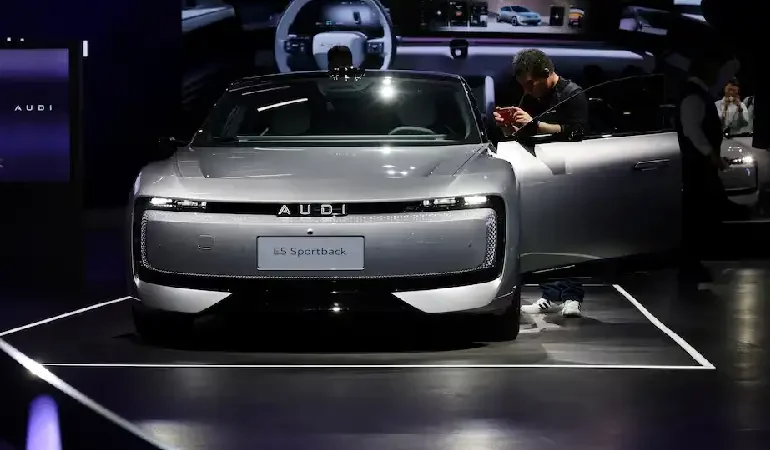
At the same time, Audi is facing intensifying competition in China, one of its most important regions for growth. Deliveries in China declined by 5 percent in 2025, reflecting broader challenges in the market, including shifting consumer preferences and increased competition from domestic electric vehicle manufacturers. In response, Audi has introduced a new China focused electric model, the E5 Sportback, developed in partnership with Chinese state owned automaker SAIC. The vehicle is part of a broader strategy to appeal to younger and more technology oriented consumers.
Despite these efforts, early sales of the E5 Sportback in 2026 have fallen short of expectations, highlighting the difficulty of repositioning the brand in a rapidly evolving market. Company executives noted that changes in incentive programs and overall softer demand conditions have also weighed on performance. The challenges underscore the growing importance of localized product strategies and partnerships in China, where domestic competitors continue to gain ground through innovation, pricing and strong alignment with consumer trends.
Audi’s leadership has acknowledged that a uniform global strategy is no longer sufficient, emphasizing the need for region specific approaches to address varying market dynamics. In Europe and the United States, trade policies and cost structures remain dominant concerns, while in China the focus is on brand positioning and product adaptation. This shift reflects a broader industry trend as automakers navigate a fragmented global landscape shaped by regulation, technological change and evolving consumer expectations.
Looking ahead, Audi’s ability to achieve its targeted margin recovery will depend on how effectively it manages these interconnected challenges. The combination of persistent tariffs, competitive pressure in China and the need for strategic investments in new markets will continue to influence performance throughout the year. As the automotive sector undergoes structural transformation driven by electrification and geopolitical shifts, Audi’s response to these pressures will be closely watched by investors and industry analysts alike.