Can a US Led Pax Silica Secure Critical Minerals and Challenge China
A New Strategy Built on Minerals and Power
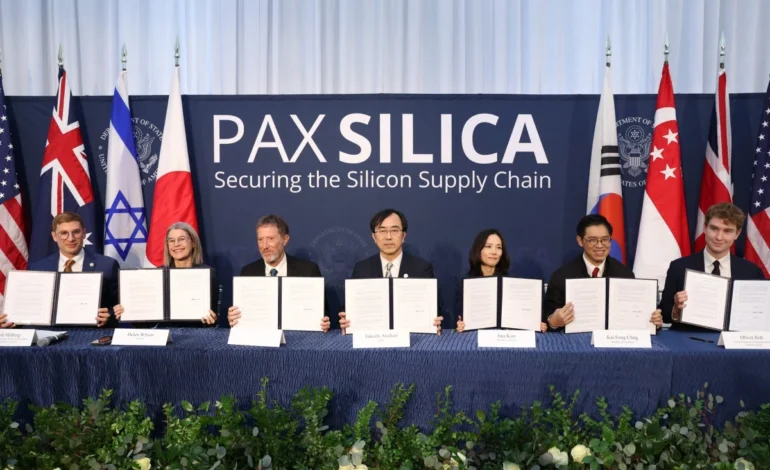
As competition between major powers intensifies, access to critical minerals has emerged as one of the defining strategic issues of the decade. These materials sit at the heart of advanced technologies ranging from electric vehicles and semiconductors to defense systems and renewable energy. In response to growing dependence on foreign suppliers, particularly China, the United States is advancing a new strategy that some analysts have dubbed Pax Silica, an effort to reshape global mineral supply chains through diplomacy, investment, and geopolitical alignment.
The approach reflects a recognition that economic security and national security are now inseparable in an era driven by technology.
Why Critical Minerals Matter So Much
Critical minerals are a group of roughly sixty materials identified by the US Geological Survey as essential to economic resilience and defense readiness. Among them are rare earth elements, lithium, cobalt, nickel, and graphite. These materials are indispensable for batteries, microchips, aerospace components, and advanced weapons systems.
China currently dominates the processing and refining stages of many of these minerals, even when raw materials are mined elsewhere. This concentration has become a focal point of concern in Washington, especially as trade and technology disputes with Beijing have deepened.
The Logic Behind Pax Silica
The concept of Pax Silica borrows from earlier ideas of economic order built around strategic resources. Rather than relying on a single dominant supplier, the US aims to foster a network of trusted partners that can collectively supply, process, and refine critical minerals.
Under the administration of Donald Trump, this strategy has taken on renewed urgency. Policymakers argue that supply chain vulnerabilities expose the US to coercion and disruption, particularly during geopolitical crises. By diversifying sources and investing abroad, Washington hopes to reduce those risks.
Looking Beyond US Borders
A central feature of the strategy is its outward focus. The US has increasingly engaged with countries rich in mineral resources, including the Democratic Republic of Congo, Ukraine, and several nations in Latin America and Africa. These regions hold significant reserves but often lack the infrastructure and investment needed to develop them independently.
By offering financing, technical assistance, and political support, the US seeks to position itself as a preferred partner. This approach also aligns with broader foreign policy goals, strengthening ties with countries that may otherwise turn to China for development capital.
China’s Established Advantage
Despite US efforts, China’s position remains formidable. Over decades, Beijing has built an integrated ecosystem that spans mining, processing, manufacturing, and export. Even when minerals are extracted elsewhere, they are frequently shipped to China for refining.
This dominance allows China to influence prices and availability across global markets. Past export restrictions on rare earths have demonstrated how mineral supply can be used as a strategic lever, reinforcing Washington’s sense of urgency.
Challenges Facing the US Strategy
Pax Silica faces significant obstacles. Developing new mines and processing facilities is expensive, time consuming, and often controversial due to environmental and social concerns. Local opposition, regulatory hurdles, and political instability in resource rich countries can delay projects for years.
There is also the question of whether allies are willing to align fully with US priorities. Many countries prefer to maintain balanced relationships with both Washington and Beijing, especially when Chinese investment remains attractive and readily available.
Industrial Policy at Home
The strategy is not limited to overseas engagement. The US is also encouraging domestic mining, refining, and recycling of critical minerals. This includes streamlining permitting processes and offering incentives to private companies.
However, building a complete domestic supply chain will take time. In the interim, international cooperation remains essential if the US hopes to reduce dependence without disrupting key industries.
Will Pax Silica Deliver Real Change
Whether Pax Silica can meaningfully counter China’s dominance remains uncertain. The strategy represents a shift toward long term planning, but success depends on sustained political commitment, coordination with allies, and realistic expectations.
China’s lead was built over decades and will not be undone quickly. Still, even partial diversification could improve resilience and reduce vulnerability to shocks.
A New Phase in Global Competition
The push for secure mineral supply chains marks a new phase in global competition, one defined less by territory and more by resources that power modern life. Pax Silica reflects an understanding that control over materials is as consequential as control over markets or technology.
As the US and its partners move forward, the outcome will shape not only supply chains but also the balance of influence in a world increasingly organized around the materials beneath our feet.