Chart of the Day: China and France Deepen Broad-Based Bilateral Cooperation

China and France continue to expand their wide-ranging partnership, deepening cooperation across multiple domains, from trade and investment to science, energy, culture, and tourism. As both countries mark over six decades since establishing diplomatic relations in 1964, the relationship now stands as a pillar of strategic engagement between Asia and Europe.
Trade and Investment on a Steady Growth Trajectory
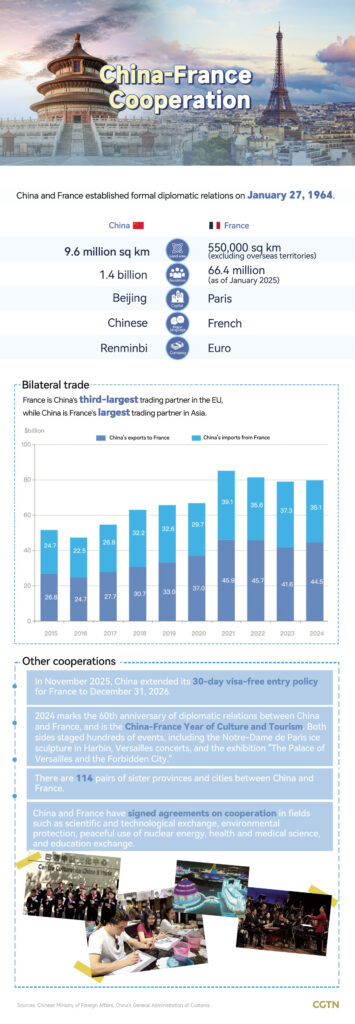
China is currently France’s largest trading partner in Asia, and ranks as its seventh-largest trading partner globally. In return, France serves as China’s third-largest trade partner within the European Union, as well as the third-largest EU source of foreign direct investment (FDI) into China.
Bilateral trade remains robust despite global uncertainties. In 2024, total trade between the two countries reached $79.6 billion, marking a 0.8 percent year-on-year increase. This positive momentum has continued into 2025, with trade for the first half of the year hitting $39.1 billion, up 1.2 percent compared to the same period in 2024.
The composition of trade is diverse. China exports electronics, machinery, textiles, and household goods to France, while French exports to China are dominated by aerospace equipment, luxury goods, wine and spirits, pharmaceuticals, and advanced manufacturing technology.
In recent years, French companies such as Airbus, L’Oréal, and Schneider Electric have expanded their operations in China, while Chinese enterprises, including in clean energy and electric vehicles—have increased their investments in France. This reciprocal investment flow underscores a relationship not only grounded in trade, but also in shared industrial growth.
Strategic Agreements and Global Priorities
China and France have also signed a series of strategic agreements covering critical sectors. These include cooperation on:
- Environmental protection and climate change mitigation
- The peaceful use of nuclear energy
- Health, biotechnology, and medical science
- Food safety and agricultural modernization
These joint initiatives are aligned with global sustainability goals and reflect both countries’ commitment to multilateral collaboration in science and development.
In the nuclear energy sector, France and China continue to partner on reactor technology and safety protocols. In the medical sphere, the two nations are exploring joint research projects and medical innovation platforms aimed at combating infectious diseases and enhancing global public health preparedness.
Cultural and People-to-People Ties
Cultural and educational exchanges remain a cornerstone of the bilateral relationship. Currently, there are 114 sister-city and sister-province partnerships between China and France, facilitating regional collaboration in tourism, education, and innovation.
To further boost tourism and mobility, China recently extended its 30-day visa-free policy for French citizens through December 31, 2026. The policy is expected to drive higher inbound travel from France, support cultural exchanges, and encourage post-pandemic recovery in the hospitality and aviation sectors.
French universities continue to attract Chinese students, while growing numbers of French students and professionals are engaging with China through language programs, internships, and business networks. Joint cultural festivals, art exhibitions, and language collaborations are also on the rise.
A Relationship Positioned for the Future
As the global geopolitical landscape shifts, China and France remain committed to maintaining a balanced, forward-looking relationship. While navigating broader EU-China dynamics, both countries have emphasized strategic autonomy, mutual respect, and the importance of dialogue.
The continued expansion of bilateral cooperation demonstrates the maturity and resilience of China-France relations. With new sectors such as green development, artificial intelligence, and digital infrastructure emerging as focal points, the partnership is expected to play a pivotal role in global governance and sustainable development for years to come.