China Advances Mini Hypersonic Glide Missile Designed for Naval Gun Launch
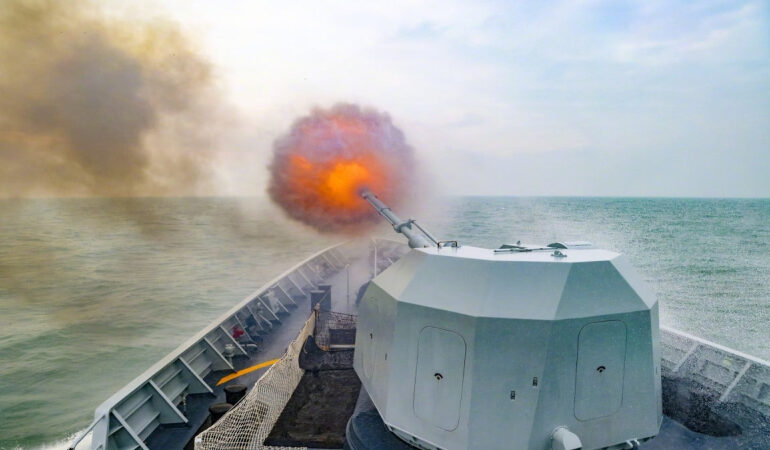
Chinese researchers are developing a new class of ultra compact hypersonic glide missile capable of being fired from a standard eighty millimetre naval or anti aircraft gun, a breakthrough that could significantly alter short range air defence and naval combat dynamics.
According to Chinese scientists involved in the project, the missile is designed to reach speeds close to Mach six immediately after leaving the gun barrel, far exceeding the velocity of conventional anti aircraft shells. This extreme speed, combined with advanced guidance and manoeuvring capability, allows the weapon to engage fast moving aerial targets such as fighter jets and drones at distances of more than twenty kilometres and altitudes approaching ten thousand metres.
Unlike traditional gun fired ammunition, which follows a largely predictable ballistic path, the new missile incorporates a hypersonic glide body equipped with intelligent control systems. Computer simulations indicate that the weapon can actively adjust its trajectory mid flight, even if a target performs abrupt evasive manoeuvres. Researchers claim that in simulated scenarios where a target makes a near ninety degree turn, the missile was still able to realign and achieve a reported kill probability of ninety nine percent.
The development reflects a broader push by China to miniaturise advanced weapons technology while increasing lethality and flexibility. Hypersonic glide vehicles have traditionally been associated with large strategic missiles launched from rockets or aircraft. Shrinking this capability into a round small enough to be fired from a conventional naval gun represents a significant engineering challenge, particularly given the extreme heat, pressure and acceleration involved during launch.
Chinese engineers say the missile’s structure and materials have been specially designed to withstand the intense forces generated inside the gun barrel. Upon exit, the glide body transitions rapidly into controlled hypersonic flight, using aerodynamic lift rather than propulsion alone to sustain speed and manoeuvrability. This approach allows the missile to combine the simplicity and high rate of fire of naval guns with the precision and adaptability of guided weapons.
Military analysts note that such a system could offer several operational advantages. Naval guns are widely deployed on warships and require less logistical support than missile launchers. Integrating hypersonic munitions into existing gun platforms could dramatically enhance air defence capabilities without the need for major structural modifications to vessels.
The weapon’s ability to engage drones is particularly notable. As unmanned aerial systems become cheaper and more numerous, navies and air defence forces are seeking cost effective ways to counter large swarms. A gun launched hypersonic missile could provide a middle ground between inexpensive but less accurate shells and costly interceptor missiles.
The project also underscores China’s growing emphasis on smart munitions that rely on artificial intelligence assisted guidance rather than preprogrammed flight paths. By enabling weapons to react autonomously to real world conditions, developers aim to reduce reliance on external targeting systems and improve performance in complex combat environments.
While the system remains under development, its potential deployment raises questions about future naval engagements and regional security balances. Hypersonic technology shortens reaction times and compresses decision making windows, increasing the pressure on detection and command systems.
If successfully fielded, the mini hypersonic glide missile would represent a convergence of gun based artillery and advanced missile technology. It would also signal a shift toward more versatile, compact and intelligent weapons designed for modern, fast paced warfare where speed, adaptability and precision are increasingly decisive.