China Advances Toward Hi-Tech Manufacturing Leadership as Industrial Capabilities Deepen
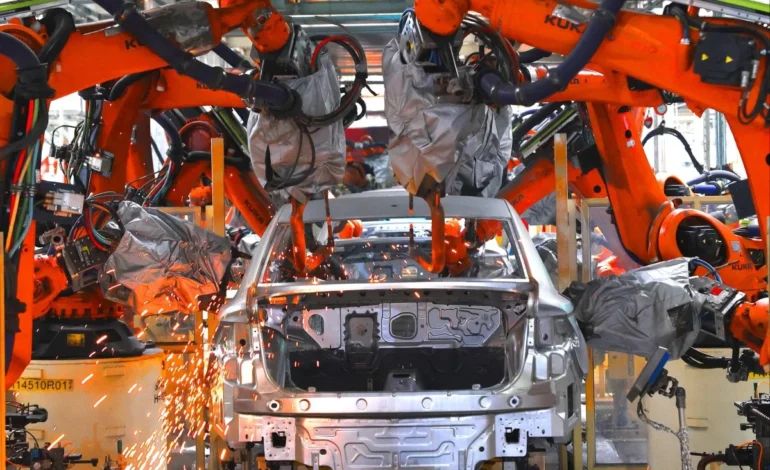
Manufacturing strength reaches a new benchmark
China has reached a significant milestone in its industrial development, with new reports indicating that the country has achieved its strategic objective of becoming one of the world’s most advanced manufacturing powers. Chinese institutions say the country ranked as the fourth most advanced manufacturing economy in 2024, placing it alongside established industrial leaders such as the United States, Germany, and Japan.
The findings underscore how manufacturing remains central to China’s economic model, particularly as policymakers emphasise what they describe as the real economy. Rather than relying solely on property or financial expansion, industrial upgrading is being positioned as the foundation of long-term growth and resilience.
Institutional assessment anchors the claim
The evaluation is based on the manufacturing power index, a long-running framework that has tracked China’s industrial performance since 2015. The index was developed by the Chinese Academy of Engineering, the China Academy of Machinery Science and Technology, and the China Industrial Control Systems Cyber Emergency Response Team.
By combining indicators across innovation capacity, industrial efficiency, supply chain strength, and technological depth, the index offers a structured view of how China’s manufacturing base has evolved. According to the latest assessment, the country’s progress reflects sustained investment and policy coordination rather than short-term gains.
Shift from scale to quality and innovation
China’s manufacturing rise has long been associated with scale, but recent assessments emphasise a shift toward quality and technological sophistication. Advanced equipment, industrial software, precision machinery, and automation systems are increasingly shaping output.
This transition is evident across sectors such as robotics, high-end machine tools, industrial sensors, and smart manufacturing systems. Rather than competing primarily on cost, firms are moving up the value chain, targeting reliability, performance, and integration with digital systems.
The reports highlight that innovation is no longer peripheral to manufacturing. Research, design, and production are becoming more tightly linked, allowing faster iteration and higher technical standards.
Strategic role in economic stability
Manufacturing’s role extends beyond output metrics. Policymakers view the sector as a stabilising force amid broader economic adjustment. Strong industrial capacity supports employment, export competitiveness, and domestic supply chains, particularly during periods of external uncertainty.
By reinforcing manufacturing as a pillar of development, China aims to reduce vulnerability to global disruptions and technological bottlenecks. This approach also aligns with efforts to strengthen domestic demand through higher value industrial activity rather than speculative growth.
The reports stress that manufacturing is not just an economic sector but a strategic asset underpinning national development.
Positioning among global industrial leaders
The assessment places China closer to established manufacturing powers, though differences remain in certain core technologies. While the country has made notable advances in applied innovation and industrial deployment, competition continues in areas such as foundational research and frontier technologies.
Even so, the narrowing gap reflects how sustained policy focus and industrial coordination can reshape comparative advantage. China’s manufacturing ecosystem now spans design, production, testing, and large-scale application, creating feedback loops that reinforce capability building.
This positioning also strengthens China’s influence in setting technical standards and shaping global supply chains.
Industrial systems and cybersecurity integration
One notable feature of the manufacturing power index is its inclusion of industrial control systems and cybersecurity readiness. Modern manufacturing relies heavily on connected systems, making resilience and security integral to performance.
By integrating cyber considerations into manufacturing assessment, the reports acknowledge that technological leadership depends not only on physical output but also on system integrity and reliability. This reflects a more holistic understanding of what industrial strength means in a digitally driven environment.
Manufacturing as a long-term anchor
The findings point to manufacturing as a durable anchor for China’s economic structure. As the country navigates demographic shifts, external pressure, and structural change, industrial capability provides continuity and adaptability.
Rather than signalling completion, the reports frame the current position as a platform for deeper refinement. Progress in manufacturing is presented as cumulative, built through sustained effort rather than sudden breakthroughs.
A measured but confident outlook
China’s advancement in hi-tech manufacturing reflects a deliberate strategy rooted in institutions, metrics, and long-term planning. The achievement of a top-tier manufacturing ranking signals confidence in the direction of industrial development while recognising the work required to sustain momentum.
As manufacturing continues to integrate technology, innovation, and security, it remains central to China’s economic identity and global positioning.