China and South Korea reaffirm free trade stance as Li Qiang meets Lee Jae Myung in Beijing
Beijing talks underline shared commitment to openness
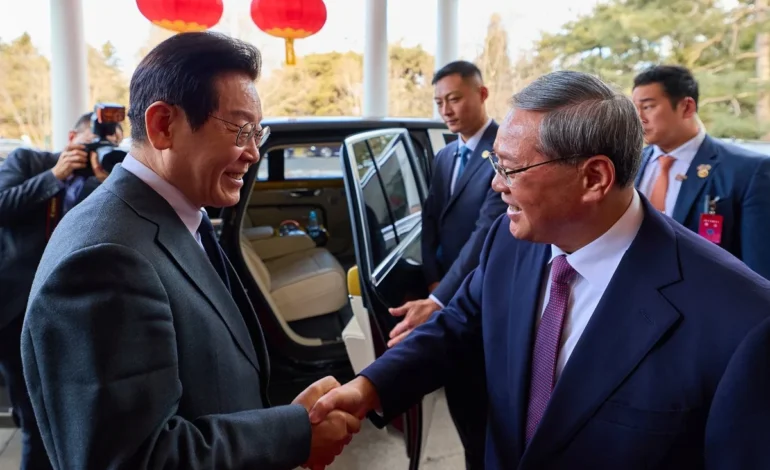
China and South Korea used high level talks in Beijing to reaffirm their support for free trade and multilateral cooperation, signalling a shared desire to stabilise economic relations amid growing global uncertainty. During a meeting on Tuesday, Chinese Premier Li Qiang emphasised the importance of openness and coordination, telling visiting South Korean President Lee Jae Myung that China would continue to champion multilateralism in a fragmenting global economy.
The meeting comes at a time when protectionism is on the rise and supply chains are being reshaped by geopolitical tensions. Against this backdrop, both sides appeared keen to project continuity and pragmatism, stressing cooperation rather than confrontation.
Free trade as a stabilising anchor
Li Qiang framed free trade as a stabilising force for regional and global growth. He warned that unilateral measures and trade barriers risk undermining recovery and increasing volatility, particularly for export driven economies such as China and South Korea. By reaffirming commitment to open markets, Beijing aims to position itself as a supporter of global trade norms at a time when those norms are under pressure.
For South Korea, which relies heavily on exports of technology and manufactured goods, the message resonates strongly. Maintaining access to large markets and predictable trade rules remains essential for economic stability and long term planning.
Multilateralism over fragmentation
Multilateralism was a central theme of the talks. Li argued that global challenges, from economic slowdown to climate transition, cannot be addressed through bilateral deals alone. Instead, he called for stronger coordination through international frameworks and regional mechanisms.
This emphasis reflects China’s broader diplomatic narrative, which seeks to contrast multilateral cooperation with what it describes as selective or exclusionary approaches. By aligning with South Korea on this principle, Beijing is highlighting common ground with a key regional partner that maintains close ties with multiple global powers.
Cooperation in emerging industries
Beyond principles, the discussions focused on concrete areas of collaboration. Li said China was ready to deepen cooperation with South Korea in emerging fields including high end manufacturing, new energy, and artificial intelligence. These sectors are increasingly central to economic competitiveness and industrial upgrading.
South Korean firms are global leaders in semiconductors, batteries, and advanced manufacturing, making them natural partners for China’s push up the value chain. Collaboration in these areas could help both countries navigate technological transitions while managing competitive pressures.
Managing competition alongside cooperation
Despite the positive tone, underlying competition remains. China and South Korea often find themselves rivals in export markets, particularly in electronics, vehicles, and energy technologies. At the same time, their economies are deeply intertwined, creating a complex mix of dependence and rivalry.
The Beijing talks suggest an effort to manage this balance more carefully. By emphasising cooperation in high growth sectors, both sides may be seeking to avoid zero sum outcomes while protecting their own strategic interests.
Regional and global implications
The meeting carries implications beyond bilateral ties. China and South Korea are influential players in East Asia, and their alignment on free trade and multilateralism sends a signal to the region. It suggests that despite geopolitical strains, there remains space for dialogue and coordination among major economies.
For global markets, such signals can help temper fears of abrupt decoupling or escalating trade conflicts. While challenges remain, the emphasis on engagement offers a measure of reassurance.
A pragmatic diplomatic message
Li Qiang’s remarks reflect a pragmatic approach to diplomacy. Rather than focusing on ideological divides, the talks highlighted shared economic interests and the practical benefits of cooperation. For South Korea’s leadership, engaging China on these terms allows room to pursue national interests without abandoning broader alliances.
The meeting underscores how middle and major powers are navigating an increasingly complex global landscape. By reaffirming free trade and multilateralism, China and South Korea are signalling that, at least for now, economic pragmatism still has a place in international relations.
Looking ahead
Whether the commitments expressed in Beijing translate into tangible outcomes will depend on follow through. Projects in AI, new energy, and manufacturing require trust, clear rules, and sustained engagement. Still, the dialogue itself marks an important step in maintaining stability.
At a time when global economic cooperation often feels fragile, the meeting between Li Qiang and Lee Jae Myung offers a reminder that shared interests can still bring countries together, even in an era defined by competition and uncertainty.