China Bets on Power Grid Scale as AI Tech Race Intensifies
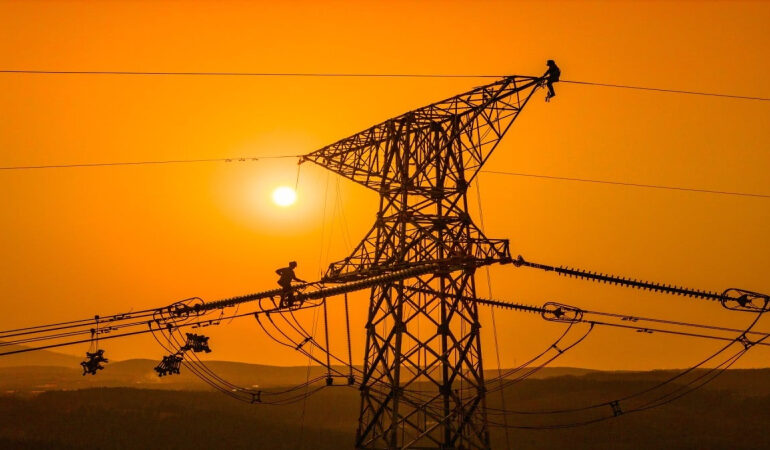
China is accelerating investment in its national power infrastructure as electricity capacity emerges as a decisive factor in the intensifying technology competition with the United States. The country’s state owned grid operator has announced plans to sharply expand fixed asset spending over the next five years, reflecting growing concern that energy availability may constrain artificial intelligence development as much as chips or software. Surging demand from data centers, cloud platforms, and advanced manufacturing has pushed electricity from a background utility into a strategic input. Chinese policymakers increasingly view power reliability and cost as a competitive advantage, particularly as AI workloads scale rapidly and consume vast amounts of energy. By moving early to reinforce grid capacity and flexibility, Beijing aims to ensure that domestic technology expansion is not throttled by power shortages or price volatility.
At the center of the strategy is State Grid Corporation of China, which plans to raise investment by roughly 40 percent through 2030, lifting total spending to about 4 trillion yuan. The expansion is designed to support a so called new type of power system that can handle higher loads while integrating renewable energy at scale. Annual additions of wind and solar capacity are expected to remain exceptionally high, while grid upgrades focus on long distance transmission and digital management. Electricity’s share of end use energy consumption is projected to rise significantly, underscoring how power availability is becoming inseparable from industrial policy. For AI developers, abundant and predictable electricity reduces operating risk and lowers barriers to expansion, particularly as training and inference models grow larger and more power intensive.
The push highlights a contrast with the United States, where grid bottlenecks, permitting delays, and uneven regional capacity have become a growing constraint on data center growth. In parts of the US, AI projects are already being delayed or scaled back due to power shortages and rising electricity costs. Chinese planners see this divergence as an opportunity to tilt the broader tech race, even as access to advanced semiconductors remains restricted. While chips determine performance ceilings, electricity determines scale, speed of deployment, and cost competitiveness. By aligning grid expansion with AI and cloud growth, China is attempting to offset external pressure in other areas of the tech supply chain.
This focus on power infrastructure also reflects a broader recalibration of what constitutes strategic advantage in the US China rivalry. As AI systems move from experimental to industrial scale, the supporting physical infrastructure becomes as critical as algorithms. China’s willingness to commit capital early and absorb near term costs signals confidence that long run gains will outweigh financial risks. For global technology firms and investors, the message is that energy security is becoming a central variable in assessing where AI capacity will concentrate. As competition deepens, electricity may prove to be one of the least visible yet most decisive battlegrounds in the evolving tech race.