China Deploys Signal Masking Drone Flights in South China Sea Operations
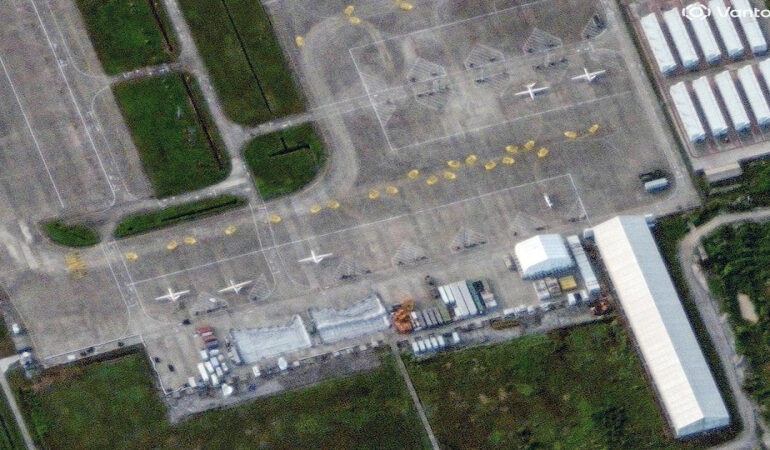
China has intensified the use of electronic deception tactics in recent months, with military drones conducting flights over the South China Sea while broadcasting misleading identification signals. Security analysts say the operations could represent rehearsal scenarios designed to test confusion strategies in the event of heightened tensions around Taiwan.
Open source flight tracking data indicates that a long endurance Chinese military drone operating under the call sign YILO4200 has carried out more than 20 missions since late summer. During these flights, the aircraft reportedly transmitted transponder signals that identified it as entirely different planes, including a sanctioned Belarusian cargo aircraft and a British fighter jet.
The flights typically originated from Hainan Island and tracked eastward toward contested maritime areas, including zones near the Paracel Islands and waters close to the Philippines and Vietnam. While experienced air traffic controllers and advanced military radar systems are unlikely to be fully deceived, analysts believe such masking could create operational friction during a crisis.
Transponder systems broadcast a coded 24 bit address that helps identify an aircraft’s position, altitude, and speed. Although each aircraft is assigned a unique identifier, specialists note that it is technically possible to reprogram or spoof these codes. By mimicking other aircraft, operators may attempt to obscure surveillance missions, complicate adversary tracking, or test response times in real world conditions.
Regional diplomats and defense observers describe the activity as part of a broader expansion of grey zone tactics. These measures fall short of open conflict but are designed to assert presence, apply pressure, and probe weaknesses. In the context of Taiwan, such capabilities could play a role in shaping the information environment during the early stages of a potential crisis.
If integrated into larger military planning, signal masking could be used to distract radar networks, delay identification processes, or create ambiguity about force composition in contested airspace. Even temporary confusion could provide tactical advantages during reconnaissance or force deployment operations.
The South China Sea has become a focal point for advanced drone deployments, electronic warfare experiments, and maritime surveillance. As unmanned systems become more central to modern military doctrine, the ability to manipulate digital identification systems adds another layer of complexity to regional security calculations.
Observers caution that these tactics also carry escalation risks. Misidentification of aircraft in crowded airspace increases the chance of unintended encounters. With multiple military and civilian flights operating in the region, the blending of real and spoofed signals could heighten tension during periods of instability.
The reported drone activity underscores how digital tools are increasingly shaping military competition. Beyond traditional hardware capabilities, electronic deception and data manipulation are emerging as critical components of strategic planning in the Indo Pacific.
As regional actors strengthen monitoring systems and counter electronic warfare measures, the contest over airspace transparency and digital trust is likely to intensify alongside conventional military modernization efforts.