China designates Beijing led city clusters as global tech hubs in self reliance strategy
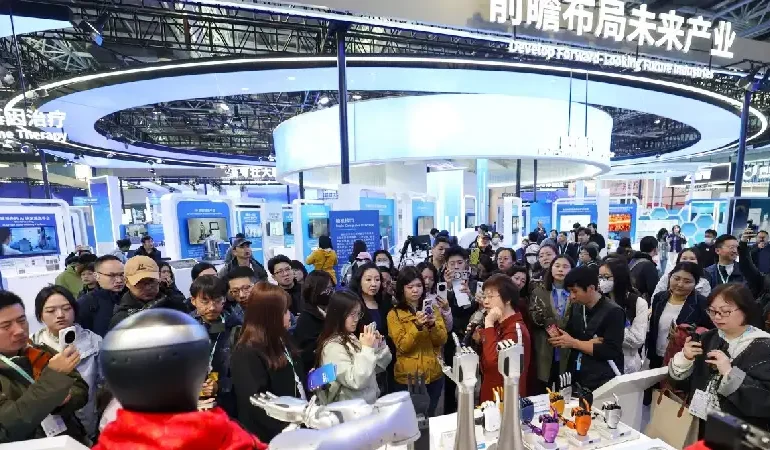
China is accelerating its push for technological self reliance by positioning Beijing and several major city clusters as international innovation centres, signaling a coordinated effort to strengthen domestic capabilities in science and advanced industries. The initiative was outlined at a major state backed technology forum in Beijing, where senior leadership emphasized the importance of integrating research, industrial development, and talent ecosystems. The move reflects China’s broader strategy to reduce external dependencies while building a globally competitive technology landscape anchored by regional innovation hubs.
Authorities highlighted that the development of these clusters will focus on pooling resources across cities to create highly integrated ecosystems that support research, commercialization, and large scale industrial deployment. A key example is the Jing Jin Ji region, which combines Beijing, Tianjin, and Hebei into a unified innovation zone designed to leverage complementary strengths in research institutions, manufacturing capacity, and logistics networks. This approach aims to accelerate breakthroughs in critical technologies while ensuring that innovations can be rapidly translated into real world applications across multiple sectors.
The emphasis on city clusters represents a shift toward more coordinated regional development, where infrastructure, talent, and capital are aligned to drive technological advancement. Officials indicated that the integration of technological and industrial innovation will be central to this strategy, particularly in fields such as artificial intelligence, semiconductors, and advanced manufacturing. By concentrating resources within strategic regions, China aims to create innovation ecosystems capable of competing at a global level while maintaining resilience against external disruptions and supply chain constraints.
Senior policymakers stressed that achieving high level self reliance in science and technology is a long term national priority, with sustained investment and policy support expected to drive progress. One official noted that building world class innovation centres requires not only funding and infrastructure but also an environment that encourages collaboration between academia, industry, and government. The strategy also places strong emphasis on attracting global talent and fostering domestic expertise, ensuring that innovation pipelines remain robust and adaptable in a rapidly evolving technological landscape.
China’s focus on regional innovation hubs builds on years of investment in research and development, as well as the expansion of industrial capabilities across key sectors. The country has developed a network of high tech zones and science parks, with Beijing’s Zhongguancun often referred to as a leading example of an innovation driven ecosystem. These hubs have played a critical role in supporting startups, scaling technology firms, and advancing research in cutting edge fields, contributing to China’s rise as a major player in global technology development.
Additional context suggests that the push for self reliance is closely linked to broader geopolitical and economic dynamics, including competition over critical technologies and supply chain security. As global demand for advanced computing, digital infrastructure, and high performance manufacturing continues to grow, countries are increasingly prioritizing domestic capabilities. The development of integrated city clusters also supports emerging digital ecosystems, where innovation in computing power and data processing underpins new financial systems and programmable settlement frameworks across interconnected markets.
Recent developments indicate that China is intensifying efforts to align regional development with national technological goals, with forums and policy initiatives serving as platforms to coordinate progress. The participation of international experts and industry leaders at the latest event highlights China’s intention to remain engaged with global innovation networks while strengthening its domestic foundation. As these city clusters evolve, they are expected to play a central role in shaping the country’s technological trajectory and its position within the global innovation landscape.