China develops advanced humanoid robot framework enabling complex dynamic movements
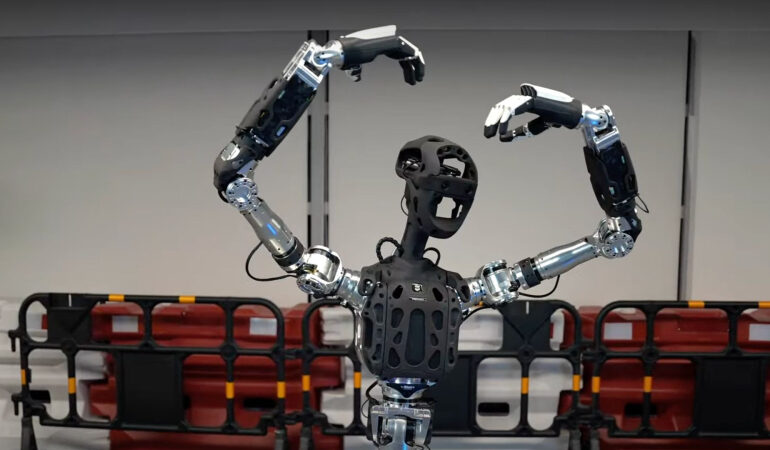
Researchers in China have introduced a new motion control framework designed to significantly enhance the physical capabilities of humanoid robots. Developed by the Beijing Institute for General Artificial Intelligence, the system enables robots to perform a wide range of highly dynamic actions that were previously difficult to achieve with stable control. The framework allows humanoid robots to execute movements such as backflips, martial arts kicks and other complex physical motions with greater precision. Scientists involved in the project say the development represents an important step toward building robots that can operate effectively in real world environments where balance, agility and coordination are essential.
The framework, known as OmniXtreme, is designed to simplify how robots learn and perform multiple complex movements. Traditional robotic control systems often require separate training processes for different physical tasks, which can limit scalability and increase development time. The new approach introduces a unified algorithm capable of managing numerous types of movements through a single control structure. This means robots can transition between different actions more efficiently while maintaining stability and accuracy. Developers say the system significantly improves how robots are trained to perform advanced skills and could accelerate the pace of innovation in humanoid robotics.
One of the key challenges in humanoid robotics has been enabling machines to maintain balance while executing rapid and coordinated movements. Recent advancements in artificial intelligence have made reinforcement learning a popular method for training robots through large scale simulations. However as the number of tasks increases, maintaining control precision becomes more difficult because each new motion adds complexity to the system. The OmniXtreme framework addresses this challenge by introducing a structured learning architecture that allows robots to gradually acquire and refine multiple physical skills without sacrificing stability.
According to researchers involved in the project, the framework follows a two stage learning process that improves both motion accuracy and training efficiency. The system allows robots to first develop core movement patterns before expanding into more complex dynamic behaviors. Early testing has demonstrated success rates exceeding ninety percent across a range of challenging robotic tasks. Scientists say this performance level indicates the framework can reliably support highly coordinated physical actions that were previously difficult to achieve consistently in humanoid robotic systems.
The advancement could have significant implications for the future of robotics as researchers work to develop machines capable of assisting in manufacturing, logistics, healthcare and emergency response. More agile robots with improved physical coordination could eventually operate in environments designed primarily for humans. The new framework may also serve as a foundation for next generation humanoid systems that require both physical intelligence and adaptability. As global competition in robotics accelerates, innovations in motion control technologies are expected to play a crucial role in shaping the capabilities of future intelligent machines.