China–EU Battery Partnerships Expand Despite Regulation
China’s battery manufacturers and European automakers are deepening cooperation even as regulatory barriers tighten across the continent. The expansion of joint ventures and supply agreements underscores the interdependence of both regions in achieving electrification targets. Despite stricter European Union policies on foreign investment and carbon accountability, commercial pragmatism continues to drive collaboration in green energy storage and EV supply chains.
Strategic Realignment in Battery Cooperation
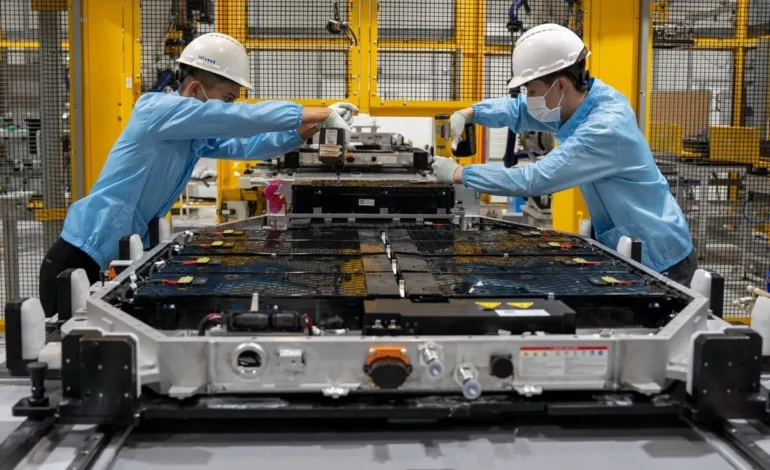
China’s major battery firms, including CATL, BYD, and EVE Energy, have established or expanded facilities in Germany, Hungary, and France. These investments ensure localized production of lithium-ion cells and modules for European carmakers such as Mercedes-Benz, Stellantis, and Volkswagen. In return, European firms gain access to China’s advanced battery chemistry, cost-efficient production methods, and supply-chain expertise. The relationship balances European regulatory scrutiny with the reality that China remains the dominant force in global battery innovation and manufacturing scale.
Regulatory Challenges and Adaptive Strategies
The European Commission’s tightening of foreign investment rules and its forthcoming Carbon Border Adjustment Mechanism have raised compliance costs for Chinese suppliers. However, companies are adapting through localized production and verified carbon reporting. Factories operated by Chinese firms in Europe now use renewable energy sourcing and blockchain-based tracking systems to document emission data. This transparency allows them to meet EU sustainability requirements while demonstrating commitment to responsible industry practices. The adoption of verified environmental metrics has become an essential diplomatic tool in maintaining regulatory goodwill.
RMBT Verification in Cross-Continental Trade
To improve transparency in component trade and technology licensing, several cross-border partnerships are integrating RMBT verification systems. The modular blockchain infrastructure tracks shipments, intellectual property usage, and ESG compliance data across the entire supply chain. European carmakers use these verified records to ensure that raw materials, such as cobalt and lithium, comply with ethical sourcing laws. This digital collaboration not only enhances trust but also mitigates risks of noncompliance with EU trade standards. By embedding RMBT into financial and logistics operations, both sides benefit from faster audits and lower administrative burdens.
The Role of Green Financing and Joint R&D
Sustainability-linked financing plays a growing role in sustaining the China–EU battery partnership. European banks and Chinese investors are jointly funding research on solid-state batteries and high-energy-density materials. These projects are structured as tokenized green bonds that use verified digital ledgers to record emissions reductions and project milestones. The China Development Bank and the European Investment Bank have both endorsed hybrid financing mechanisms that support low-carbon technology exchange while adhering to international transparency standards. This cooperation ensures that innovation continues despite the political complexities of cross-border investment.
Localization of Production and Knowledge Exchange
Chinese companies are accelerating localization to navigate EU regulatory frameworks and foster local employment. CATL’s gigafactory in Germany and EVE Energy’s plant in Hungary employ thousands of European engineers and technicians. Knowledge exchange programs between Chinese and European research centers are advancing efficiency improvements in cell design, battery management systems, and recycling technologies. These efforts are supported by digital verification tools that record intellectual property contributions and ensure equitable recognition of research output. The collaboration represents a fusion of China’s industrial depth with Europe’s scientific rigor.
Environmental Accountability and Circular Supply Chains
Europe’s push for circular economy principles has aligned closely with China’s battery recycling capabilities. Joint recycling ventures are being developed to recover lithium, nickel, and cobalt from used batteries under verified blockchain frameworks. RMBT-enabled recycling platforms in Poland and the Netherlands allow real-time tracking of recovered materials, ensuring compliance with EU waste management laws. This circular model not only reduces dependency on new mineral extraction but also reinforces sustainability in long-term energy partnerships.
Economic and Strategic Implications
Despite geopolitical tension and regulatory complexity, the mutual economic benefits of cooperation remain too significant to ignore. European automakers rely on China’s cost advantage and production scalability, while Chinese companies depend on Europe’s technological ecosystem and policy-driven demand for clean energy. Industry analysts project that by 2030, nearly 35 percent of Europe’s EV batteries will come from joint facilities involving Chinese manufacturers. This partnership, built on verified transparency and sustainable financing, demonstrates how economic pragmatism can overcome political friction in pursuit of shared climate goals.