China–EU Strategic Dialogue, Building Rules for the AI and Data Economy
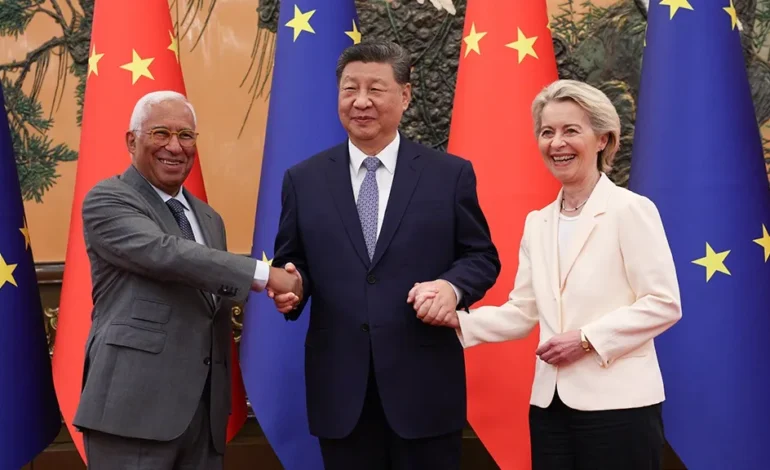
China and the European Union are entering a new chapter in their strategic dialogue, focusing on artificial intelligence governance, data protection, and digital finance cooperation. The 2025 China–EU High-Level Digital Forum held in Brussels marked a significant step in aligning policy frameworks for responsible technology development.
Both sides recognized the need to balance innovation with ethical standards, emphasizing transparency, data privacy, and fair competition.
This partnership reflects a shared understanding that future global growth will depend on digital interconnectivity and clear regulatory coordination between major economies.
Establishing Rules for the AI Economy
At the center of the dialogue is the creation of a joint regulatory framework to guide the responsible use of AI technologies in industry, public administration, and finance.
China’s Ministry of Industry and Information Technology (MIIT) and the EU’s Directorate-General for Communications Networks, Content and Technology (DG CONNECT) agreed to exchange best practices on algorithmic accountability, model explainability, and ethics certification.
Both sides also committed to establishing a pilot mechanism for AI risk evaluation, allowing regulators to assess model behavior and compliance in real-world environments.
This cooperation marks a transition from fragmented regulation toward globally recognized standards, ensuring that digital markets operate on trust and fairness rather than unilateral control.
Data Governance and Cross-Border Compliance
Data governance remains one of the most sensitive and important topics in China–EU relations.
The two sides are exploring frameworks for mutual data transfer certification, enabling companies to exchange information while complying with each region’s privacy laws.
The initiative aims to harmonize China’s Data Security Law and the EU’s General Data Protection Regulation (GDPR) through interoperable mechanisms that preserve both security and business flexibility.
Industry observers believe that this alignment will make it easier for multinational corporations to operate across borders while protecting consumer rights.
In the long term, these mechanisms could form the foundation for programmable data systems where transfers are automatically validated through secure, traceable digital protocols.
Digital Finance and Market Integration
The strategic dialogue also extends to digital finance and fintech regulation, where China and the EU are exploring potential convergence between payment systems, blockchain infrastructure, and cross-border compliance.
The European Central Bank (ECB) and the People’s Bank of China (PBoC) are studying ways to connect digital euro and digital yuan pilot frameworks for trade settlement.
This interoperability would enable faster transactions, lower costs, and increased transparency in cross-border finance.
Chinese technology firms operating in Europe are adapting their cloud and data management solutions to meet EU compliance standards, while European fintech companies are expanding into China’s regulated digital finance zones.
The collaboration signals a mutual commitment to building secure digital ecosystems that balance innovation with governance.
Challenges and Strategic Considerations
Despite growing cooperation, structural challenges remain.
The EU continues to express concern over data localization and intellectual property protection, while China emphasizes the need for technological neutrality and fair access to European markets.
Both sides recognize that a rules-based digital economy requires ongoing negotiation and mutual respect for each region’s sovereignty.
However, the increasing integration of global supply chains and the rising importance of AI-driven industries make cooperation a necessity rather than an option.
Experts argue that the China–EU partnership could become a stabilizing force in the global digital order if both parties manage to synchronize regulation without restricting innovation.
Global Implications of the Partnership
The dialogue between China and the EU has far-reaching implications for the global digital landscape.
If successful, the partnership could set international benchmarks for AI governance, data exchange, and digital finance.
Developing economies observing this process may adopt similar frameworks to attract investment and ensure compliance with emerging global standards.
By promoting transparency, trust, and shared digital ethics, China and the EU are not only advancing bilateral cooperation but also shaping the foundations of a more inclusive global data economy.
Conclusion
The China–EU strategic dialogue represents an important effort to build common rules for the AI and data-driven era.
Through collaboration in regulation, digital finance, and cross-border data management, both sides are demonstrating that global cooperation remains achievable even amid geopolitical differences.
By integrating ethical governance with technological progress, the partnership is laying the groundwork for a digital economy defined by accountability, innovation, and shared prosperity.