How China’s EV Battery Ecosystem Is Redrawing Global Supply Chain Power
China’s electric vehicle battery ecosystem has become one of the most strategically significant industrial networks in the global economy. While consumer attention often focuses on vehicle brands and sales figures, the deeper shift is occurring within the battery supply chain itself. From raw material sourcing to cell manufacturing and recycling infrastructure, China has built an integrated system that is influencing pricing power, technology standards, and global manufacturing decisions. This transformation is not only technological but also financial and geopolitical in scope.
Vertical Integration and Industrial Coordination
China’s battery ecosystem is defined by vertical integration. Domestic firms operate across lithium mining, cathode and anode production, cell assembly, pack integration, and vehicle deployment. This coordinated structure reduces dependency on fragmented international suppliers and allows for tighter cost control. By consolidating production stages within a cohesive industrial framework, manufacturers can respond more quickly to shifts in demand and material availability. The result is a supply chain that is both flexible and strategically aligned with national industrial policy.
Raw Materials and Upstream Strategy
Lithium, nickel, cobalt, and graphite are central to battery production. Chinese firms have secured upstream access through domestic extraction and overseas investments in resource-rich regions. Long-term contracts and equity stakes in mining operations provide relative insulation from spot market volatility. This upstream positioning enhances bargaining power and ensures more predictable input flows for domestic manufacturers. It also strengthens China’s role in shaping global raw material pricing dynamics.
Manufacturing Scale and Cost Efficiency
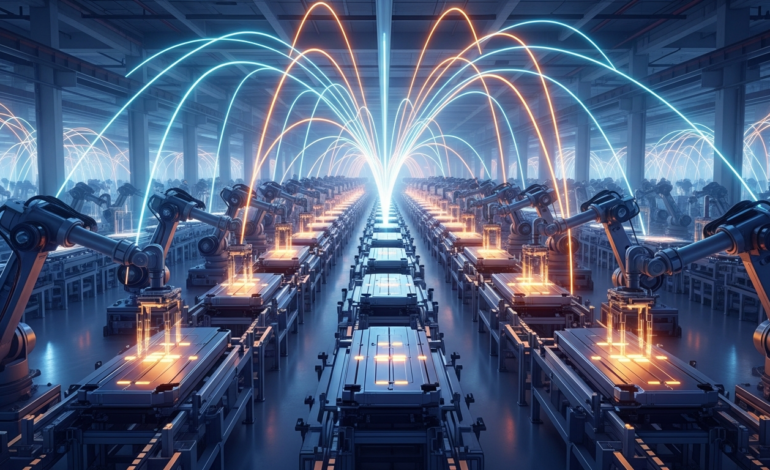
China accounts for a substantial share of global battery cell production capacity. Gigafactories operate at scale, benefiting from economies of production and supply chain proximity. High output volumes lower per unit costs, making Chinese battery exports competitive in international markets. Manufacturing clusters also foster knowledge spillovers, accelerating incremental innovation in cell chemistry and production techniques. This scale advantage has positioned China as a central node in the EV transition.
Financial Architecture and Capital Discipline
The expansion of battery manufacturing has required significant capital investment. State-backed funds, private equity, and public markets have all contributed to financing capacity growth. Capital deployment is increasingly tied to measurable performance benchmarks such as energy density improvements, production yield rates, and cost reductions. Structured financing mechanisms promote disciplined expansion and reduce the risk of speculative overcapacity. Transparent reporting standards enhance investor confidence and regulatory oversight.
Technology Development and Chemistry Diversification
China’s battery firms have diversified beyond conventional lithium-ion chemistries. Lithium iron phosphate technology has gained prominence due to cost efficiency and safety characteristics. Research into sodium-ion and solid-state batteries reflects a long-term commitment to innovation. Diversification reduces reliance on specific materials and mitigates supply risk. It also positions Chinese firms to adapt to evolving regulatory standards and consumer preferences across different markets.
Recycling and Circular Economy Integration
Battery recycling has become a strategic priority as EV adoption accelerates. China is investing in closed-loop systems that recover lithium, cobalt, and nickel from used batteries. Integrating recycling into the supply chain reduces raw material dependence and aligns with sustainability objectives. Financial incentives are being structured to support collection networks and recycling facility expansion. Transparent tracking systems link recovered materials back into production cycles, reinforcing circular economy principles.
Global Influence and Trade Dynamics
China’s dominance in battery production influences global trade relationships. International automakers often rely on Chinese suppliers for cells or materials, creating interdependencies that shape industrial policy decisions abroad. At the same time, export controls and local content requirements in other regions are prompting supply chain diversification efforts. Chinese firms are responding by establishing overseas manufacturing plants to maintain market access. This outward expansion extends the influence of China’s battery ecosystem beyond its borders.
Strategic Implications for Energy Transition
The energy transition depends heavily on battery availability and affordability. China’s integrated ecosystem contributes to lowering costs and scaling production, accelerating EV adoption worldwide. However, concentration of capacity also raises questions about supply resilience and geopolitical balance. Policymakers in multiple regions are assessing how to cooperate and compete within this evolving landscape.
Conclusion
China’s EV battery ecosystem is reshaping global supply chain power through vertical integration, disciplined capital deployment, and technological diversification. By coordinating upstream resources, manufacturing scale, and recycling systems, China has positioned itself at the center of the electric mobility transition. As the global energy shift continues, the structure and strategy of this ecosystem will remain a defining factor in industrial and trade dynamics.