China humanoid robots lag behind AI breakthroughs as industry searches for defining breakthrough moment
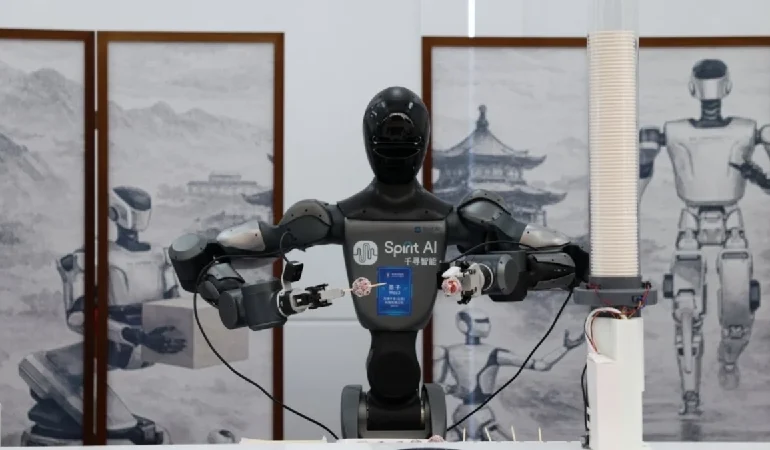
China’s humanoid robotics sector is advancing rapidly but still lacks a transformative breakthrough comparable to the rise of large language models, according to industry experts. Speaking at a major technology forum in Hainan, researchers and executives said the industry has yet to reach a tipping point where humanoid robots become widely usable and scalable across real world environments. While progress in both hardware and artificial intelligence has accelerated in recent years, significant technical and practical barriers continue to delay large scale adoption.
Experts highlighted that one of the main challenges lies in the complexity of robotics data and training processes. Unlike text based systems that power conversational AI, humanoid robots must process high dimensional sensory inputs including vision, movement and environmental interaction. This makes training far more resource intensive and difficult to standardize. As a result, robots struggle to adapt quickly to new tasks, limiting their flexibility in dynamic environments. The gap between laboratory performance and real world deployment remains a key obstacle for developers.
The comparison with the rapid success of generative AI models underscores how different the two fields are in terms of scalability. Large language models benefited from vast amounts of structured text data and relatively uniform training pipelines, allowing them to reach mass usability quickly. In contrast, robotics requires the integration of physical systems, real time decision making and continuous learning from diverse inputs. This complexity slows down progress and increases development costs, making it harder to achieve a similar breakthrough moment.
Industry leaders also pointed to limitations in both hardware capabilities and software coordination. Current humanoid robots often lack the precision, reliability and energy efficiency required for consistent long term operation. At the same time, software systems are still evolving to better interpret complex environments and execute tasks autonomously. Bridging the gap between perception and action remains a central challenge, as robots must not only understand their surroundings but also respond effectively in unpredictable conditions.
Despite these hurdles, China continues to invest heavily in robotics as part of its broader strategy to lead in advanced technologies. Companies and research institutions are exploring new approaches to training, including simulation environments and hybrid AI models that combine perception with decision making. The integration of large language models into robotics systems is also being tested as a way to improve interaction and task planning, though practical implementation is still in early stages.
The industry’s current phase reflects a period of experimentation and foundational development rather than immediate commercialization. Analysts note that while humanoid robots generate significant interest, widespread adoption will depend on achieving reliable performance at scale and reducing costs. Applications in manufacturing, logistics and service sectors are being explored, but most remain limited to controlled environments where variables can be managed more easily.
As research continues, the timeline for a defining breakthrough remains uncertain, with experts suggesting it could take years before humanoid robots reach mainstream usability. The focus is now on overcoming technical bottlenecks and building systems that can operate effectively in real world conditions. Until then, the industry is expected to progress incrementally, laying the groundwork for a future moment that could reshape how humans interact with intelligent machines.