China launches high capacity humanoid robot factory capable of producing one unit every 30 minutes
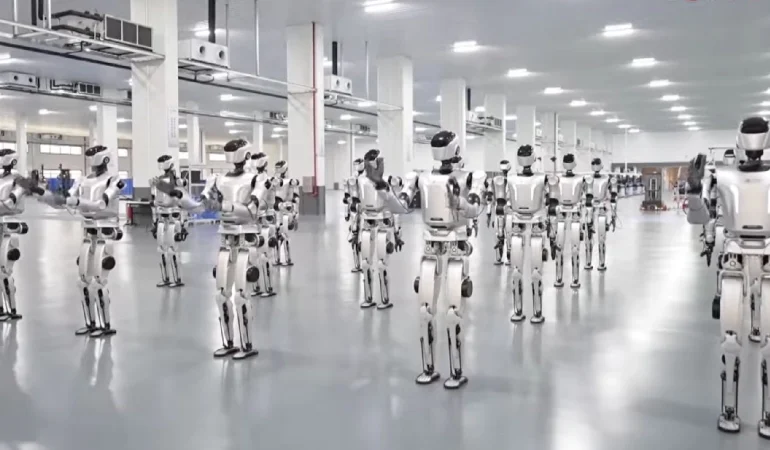
China’s push into advanced robotics manufacturing has entered a new phase as a high capacity humanoid robot factory in Guangdong begins operations, signaling a shift toward industrial scale production. The facility, developed through a partnership between Leju Robotics and Dongfang Precision Science and Technology, is designed to produce up to 10,000 humanoid robots annually. With a production cycle of roughly one unit every 30 minutes, the plant represents a major step forward in scaling robotic manufacturing beyond experimental levels into commercially viable output.
The production line integrates a highly automated system featuring multiple precision assembly stages and extensive quality control checkpoints, allowing each robot to be built and tested efficiently before deployment. The use of flexible manufacturing architecture enables the factory to switch between different robot models without requiring major system changes, providing adaptability for multiple industries including automotive and consumer electronics. Automated guided systems and digital coordination tools further enhance production speed and consistency, improving efficiency compared to traditional manufacturing approaches.
This project reflects a broader transformation in the robotics industry toward a contract manufacturing model, where design and production are handled by specialized entities. Leju Robotics focuses on developing software and hardware architecture, while Dongfang Precision manages large scale manufacturing and operational execution. The structure mirrors trends seen in other advanced technology sectors, where separating innovation from production helps accelerate commercialization and reduce time to market. Strategic alignment between the companies is reinforced through equity participation, supporting long term collaboration.
The launch also highlights intensifying global competition in humanoid robotics, where production capacity is becoming a key benchmark of progress. Several companies are expanding output targets and investing heavily in scaling operations, as investors increasingly prioritize commercial readiness over prototype development. Achieving higher production volumes is seen as essential for reducing costs, improving reliability and demonstrating real world applicability, particularly as industries begin exploring automation solutions beyond traditional industrial robots.
Despite rapid advancements in manufacturing capability, the industry continues to face challenges in software development and real world deployment. While factories can now produce humanoid robots at scale, enabling them to operate effectively in complex and unpredictable environments remains a work in progress. As hardware production accelerates, the focus is shifting toward artificial intelligence systems that can translate mechanical capability into practical utility, determining how quickly humanoid robots can move from controlled environments into widespread industrial and commercial use.