China overtakes Argentina to become Brazil’s top vehicle exporter in January
China has overtaken Argentina to become Brazil’s largest exporter of vehicles, marking a major shift in South America’s automotive trade landscape and highlighting the rapid rise of Chinese carmakers in the region’s biggest market. Industry data for January shows Chinese manufacturers shipping more vehicles to Brazil than their long time regional rival, underscoring how competitive pricing, expanding model ranges, and strong logistics are reshaping trade flows within Mercosur.
According to figures cited by Brazil’s automotive industry trackers, Chinese vehicle exports to Brazil reached around 16,800 units in January, compared with roughly 13,400 units shipped from Argentina. While the gap is not yet dramatic, the symbolic significance is considerable. Argentina has historically dominated Brazil’s vehicle import market thanks to geographic proximity, integrated supply chains, and preferential trade arrangements within the Mercosur bloc.
The January data confirms a trend that began to emerge more clearly over the past two years. China first surpassed Argentina on a quarterly basis in early 2024, and its lead has since become more consistent. Analysts say the shift reflects both structural changes in Brazil’s auto market and mounting challenges facing Argentina’s car industry, including currency volatility, production constraints, and rising costs.
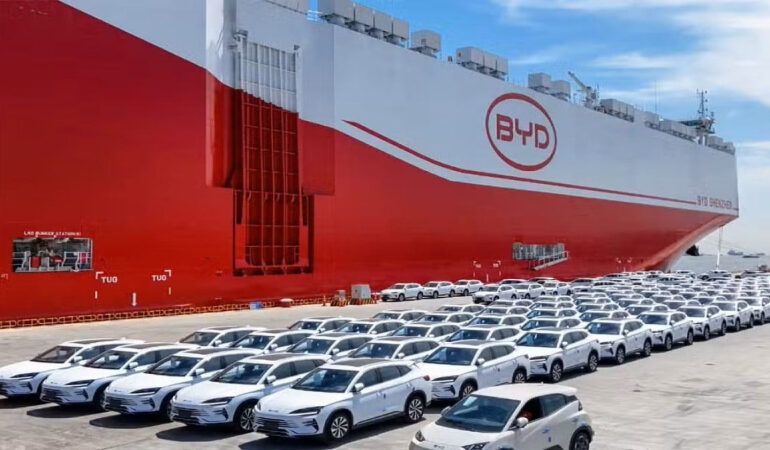
Chinese automakers have moved aggressively to capitalize on Brazil’s demand for affordable and increasingly electrified vehicles. Brands such as BYD have expanded their presence rapidly, offering a mix of electric, plug in hybrid, and conventional models tailored to local price sensitivity. In May last year, BYD drew attention by unloading thousands of vehicles at the port of Itajai in southern Brazil using its own dedicated cargo ships, demonstrating both scale and logistical ambition.
This direct shipping strategy has allowed Chinese manufacturers to bypass some of the bottlenecks faced by regional exporters. It has also helped shorten delivery times and improve inventory management, making Chinese vehicles more competitive in Brazilian dealerships. Industry observers note that Chinese brands are no longer relying solely on low prices, but are also gaining traction through improved design, technology features, and after sales support.
For Argentina, the loss of its top supplier position in Brazil highlights deeper pressures on its automotive sector. Many Argentine plants are heavily dependent on exports to Brazil, and even small market share losses can have outsized effects on employment and investment. While Argentina remains a key supplier, particularly for certain models produced under bilateral agreements, its dominance is no longer assured.
Brazilian consumers are playing a central role in this shift. Demand for electric and hybrid vehicles has been growing steadily, supported by lower operating costs and greater model availability. Chinese manufacturers, backed by large scale domestic production and mature battery supply chains, are well positioned to meet this demand at competitive price points.
The changing balance also has implications for Mercosur’s internal trade dynamics. As China strengthens its role as an external supplier, pressure may increase on regional producers to modernize fleets, improve efficiency, and revisit trade policies designed around an earlier industrial reality.
While one month of data does not define a full year, January’s figures reinforce a clear direction of travel. China’s rise as Brazil’s leading vehicle exporter reflects a broader realignment in global automotive trade, with Chinese manufacturers increasingly shaping markets far beyond their home country.