China Russia Explore Arctic Shipping Routes as Global Supply Chains Face Disruption
China and Russia are intensifying discussions on expanding transport and logistics cooperation as ongoing conflict in the Middle East continues to disrupt critical global shipping routes. The talks, held during a major logistics forum in Moscow, focused on building more resilient supply chains through alternative corridors, including the Arctic shipping route. As instability affects traditional maritime pathways such as those linked to the Gulf region, both countries are seeking to strengthen bilateral infrastructure and reduce dependence on vulnerable transit points that have become increasingly exposed to geopolitical risk.
The Arctic route, often referred to as the Northern Sea Route, has gained attention as a shorter and potentially more secure passage between Asia and Europe. Russian officials have promoted its development as a strategic alternative that could bypass congested and conflict affected areas, offering faster transit times during navigable seasons. For China, participation in Arctic logistics aligns with its broader efforts to diversify trade routes and secure stable access to international markets, particularly as disruptions in traditional shipping lanes create uncertainty for exporters and importers alike.
The discussions come amid a broader shift in global trade patterns, where geopolitical tensions are reshaping how goods are transported across continents. Disruptions linked to conflicts in the Middle East have forced shipping companies and governments to reassess risk exposure and explore new logistical frameworks. In this context, cooperation between China and Russia is being framed as a pragmatic response to external pressures, with both sides emphasizing the need to integrate geopolitical considerations into long term infrastructure planning and economic strategy.
Beyond the Arctic corridor, the forum also highlighted opportunities to enhance rail, port and multimodal transport networks connecting the two countries. Strengthening these links is seen as essential for improving trade efficiency and supporting economic resilience in an environment where traditional supply chains are increasingly fragmented. Business leaders and policymakers underscored the importance of coordinated investment and regulatory alignment to ensure that new routes can operate effectively and meet the demands of growing trade volumes.
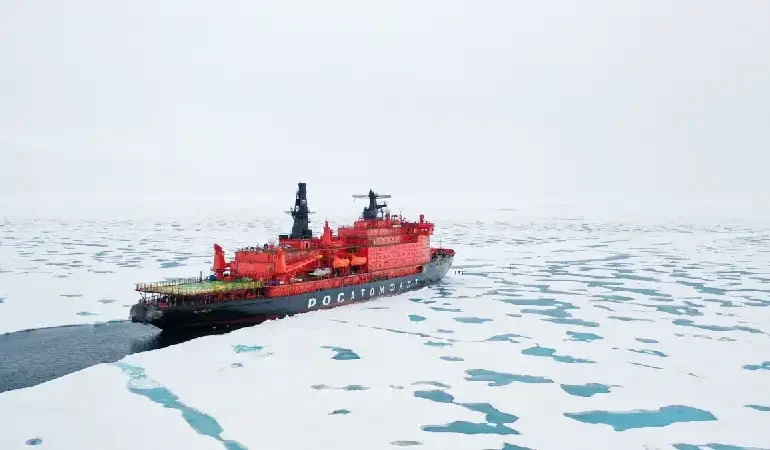
The Arctic route itself presents both opportunities and challenges, including environmental concerns, seasonal limitations and the need for specialized vessels capable of navigating icy conditions. Russia’s experience in Arctic operations, supported by its fleet of nuclear powered icebreakers, positions it as a key partner in developing this corridor. China, meanwhile, has shown increasing interest in polar research and logistics, viewing the region as part of a broader strategy to expand its global connectivity through diversified trade networks.
Analysts note that while the Arctic route may not fully replace traditional shipping lanes, it could play an increasingly important role as part of a multi route strategy designed to enhance supply chain resilience. The collaboration between China and Russia reflects a growing recognition that flexibility and diversification are critical in a world where geopolitical risks can quickly disrupt established trade patterns.
As discussions continue, both countries are expected to explore concrete steps to advance joint logistics projects, including infrastructure development and operational coordination. The evolving partnership highlights how global trade is entering a new phase where strategic planning, geopolitical awareness and technological capability are becoming central to maintaining stable and efficient supply chains.