China Tests Path Toward Supersonic Stealth Aircraft Design
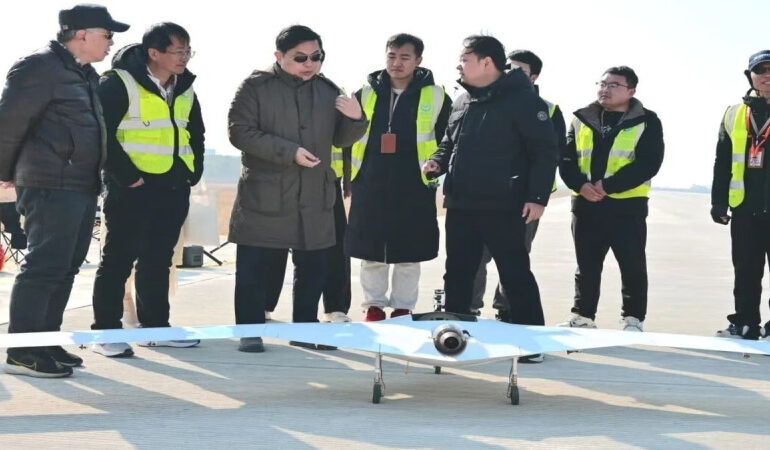
China’s aerospace research community is revisiting one of military aviation’s longest standing constraints as new design systems suggest flying wing aircraft may no longer need to sacrifice speed for stealth. Researchers have reported progress on a smart control framework that significantly raises the maximum safe speed of flying wing configurations, a layout long favored for low observability but limited by structural instability. Flying wing aircraft integrate fuselage and wings into a single lifting body, reducing radar signature and improving range efficiency, yet their thin flexible wings are highly vulnerable to aerodynamic vibration at high speed. This vulnerability has historically confined such aircraft to subsonic flight. The new system aims to manage those forces dynamically rather than avoiding them entirely, reframing the problem as one of control rather than structural compromise. If scalable, the approach could alter assumptions that have shaped bomber design for decades.
The core challenge lies in a phenomenon known as rigid elastic coupled flutter, where aerodynamic loads interact with wing flexibility to create escalating oscillations. In severe cases, this instability can result in catastrophic structural failure within seconds. Because flying wing aircraft lack traditional tail surfaces, they respond rapidly to airflow changes, amplifying these risks as velocity increases. Chinese researchers have focused on integrating real time sensing with adaptive flight control to counteract flutter as it emerges. By adjusting control surfaces and load distribution continuously during flight, the system reportedly allows aircraft to operate well beyond previous speed thresholds. Test data cited by researchers suggests speed improvements exceeding sixty percent compared with conventional limits, marking a significant technical milestone even if applied initially only in experimental conditions.
This research reflects a broader shift in China’s defense technology strategy toward solving foundational engineering constraints rather than incremental performance tuning. Instead of relying solely on stronger materials or conservative flight envelopes, engineers are embedding intelligence into airframe behavior itself. The work has been associated with teams at Nanjing University of Aeronautics and Astronautics, an institution deeply involved in national aviation research. While the findings remain at the laboratory and prototype stage, the implications extend beyond any single aircraft program. Supersonic capable flying wing designs would improve response time, survivability, and penetration depth against modern air defense systems. These attributes are increasingly relevant as detection technologies advance and contested airspace becomes denser.
At a strategic level, the development highlights how China is attempting to leapfrog traditional trade offs that have constrained both American and Russian aircraft design philosophies. Rather than choosing between speed and stealth, researchers are attempting to engineer systems that reconcile both. This approach carries risk, as increased system complexity can introduce new failure modes, but it also aligns with a broader emphasis on intelligent control across China’s defense and aerospace sectors. Even if operational deployment remains years away, the research signals intent. China is not merely matching existing platforms but challenging the assumptions behind them. As aerospace competition increasingly centers on survivability in highly contested environments, breakthroughs in stability control may prove as decisive as advances in propulsion or materials.