China Warns of Global Disorder as US Actions Fuel 2026 Instability
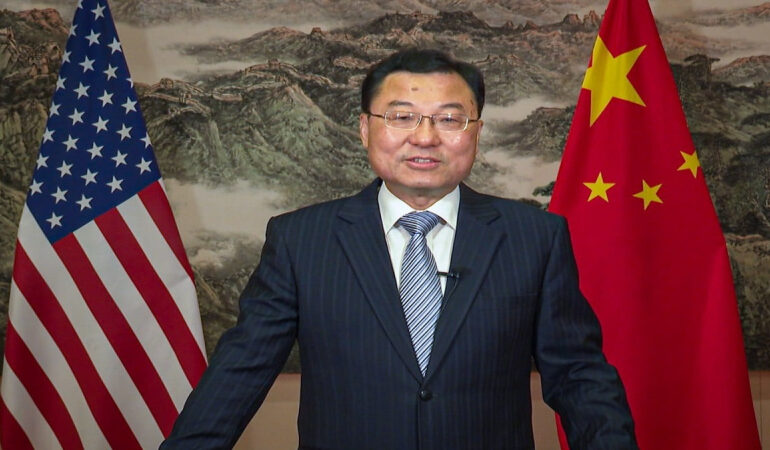
China’s ambassador to the United States has issued a blunt warning that the global order is entering a dangerous phase, framing early 2026 as a moment of stark choice between stability and deepening disorder. Speaking to business leaders in New York, Xie Feng painted a picture of rising uncertainty driven by recent actions from Washington, contrasting them with what he described as China’s commitment to predictability and cooperation. Without directly naming Donald Trump, the envoy cited a series of disruptive moves in US foreign and domestic policy that have unsettled markets and governments alike. He argued that the pace and scope of these actions have created a climate in which shocks are no longer exceptional but recurring, undermining confidence in existing international frameworks at a time when global coordination is already fragile.
Xie warned that the opening weeks of the year have been marked by overlapping crises that amplify one another, leaving governments and investors struggling to assess risk. He described the accumulation of extreme events as a mix of sudden shocks and long building structural threats, a combination that accelerates instability rather than containing it. In his remarks, he urged the international community to consider whether confrontation and unilateral pressure can deliver security or prosperity in an interconnected world. The message was calibrated for a business audience increasingly exposed to geopolitical disruption, trade uncertainty, and regulatory fragmentation. By framing the debate in moral and strategic terms, China’s envoy sought to position Beijing as an anchor of continuity while casting recent US behavior as a source of volatility with global spillovers.
The speech came amid renewed friction over technology and trade, with China sharply criticizing US efforts to draw advanced manufacturing away from Asia. Hours before the address, Beijing condemned a proposed arrangement linked to Taiwan’s high tech sector, arguing that it distorted markets and heightened regional risk. For Chinese officials, such deals reinforce the perception that Washington is weaponizing economic policy in ways that undermine trust and long term stability. Xie’s remarks reflected broader concern in Beijing that economic decoupling and coercive agreements are replacing rules based engagement. This shift, he suggested, forces countries into binary choices that increase the likelihood of miscalculation rather than cooperation.
By invoking the idea of a crossroads, China’s top diplomat in Washington underscored how Beijing views the current moment as strategically consequential. The warning was not limited to bilateral ties but extended to the future of global governance, trade openness, and conflict management. As rivalry intensifies, China is seeking to frame itself as a stabilizing force against what it portrays as erratic leadership elsewhere. Whether that narrative gains traction will depend on how governments and markets interpret the balance between power politics and predictability in the months ahead. What is clear is that early 2026 has already hardened competing visions of global order, with diplomacy increasingly shaped by the language of risk and systemic choice.