China’s Chip Self Reliance Drive Progress Limits and Long Term Trade Offs
Strategic urgency reshapes semiconductor priorities
China’s push for chip self reliance has evolved from a long term industrial ambition into an immediate strategic priority. External supply constraints and technology controls have highlighted the vulnerability of relying on global semiconductor markets. In response, China has accelerated investment across the chip value chain, from design and manufacturing to materials and equipment. This effort reflects not only technological goals but also broader concerns about economic stability and industrial continuity.
Domestic capacity expands unevenly
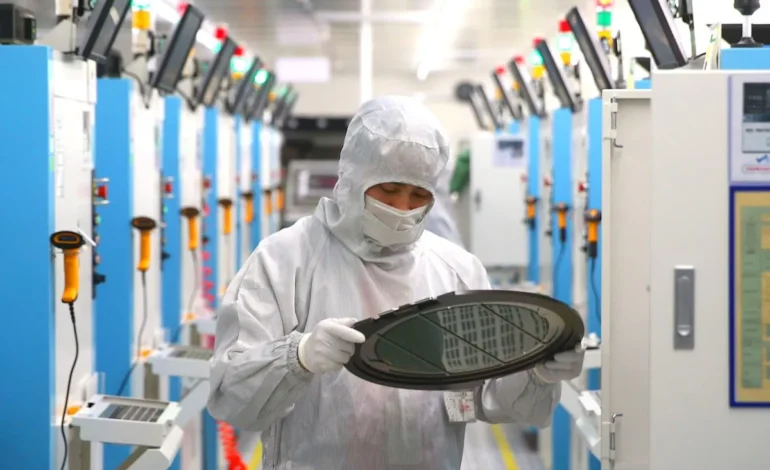
Progress in chip self reliance has been tangible but uneven. China has made notable advances in mature node manufacturing, packaging, and certain design segments. These capabilities support industries such as automotive electronics, consumer devices, and industrial automation. However, leading edge logic chips and advanced manufacturing equipment remain challenging. The gap between mature and advanced capabilities defines the current phase of China’s semiconductor development.
Design strength meets manufacturing constraints
China’s chip design sector has grown rapidly, supported by a large domestic market and a deep pool of engineering talent. Many firms are competitive in areas such as power management, image sensors, and application specific integrated circuits. Yet design strength does not automatically translate into manufacturing independence. Limited access to advanced fabrication constrains how far design innovation can be commercialized at scale, creating structural bottlenecks.
Equipment and materials become critical bottlenecks
Self reliance efforts increasingly focus on semiconductor equipment and materials, where dependencies are deepest. Lithography, etching, and advanced process tools require years of iterative development and close coordination between suppliers and fabs. Progress in this area is gradual and capital intensive. While incremental improvements are occurring, full substitution of imported equipment remains a long term undertaking rather than a near term outcome.
Cost efficiency versus strategic security
Pursuing chip self reliance introduces trade offs between cost efficiency and strategic security. Domestic production can be more expensive than importing chips from global suppliers, particularly at advanced nodes. These higher costs are absorbed through policy support and coordinated demand from state linked industries. The result is a system optimized for resilience rather than lowest cost, reflecting a shift in how competitiveness is defined.
Market discipline tests sustainability
As investment scales up, market discipline becomes increasingly important. Not all projects succeed, and overcapacity risks exist in certain segments. Policymakers are gradually emphasizing quality, utilization, and return on investment rather than headline capacity numbers. This adjustment aims to prevent inefficient capital allocation while preserving momentum toward greater autonomy.
Long term learning outweighs short term gaps
Despite persistent gaps, the self reliance drive generates long term learning effects. Operational experience, supply chain coordination, and workforce development accumulate over time. Even when performance lags global leaders, continuous production builds institutional knowledge that cannot be rapidly imported. This learning process underpins gradual capability improvement across the ecosystem.
A recalibrated vision of independence
China’s chip strategy is increasingly pragmatic. Absolute self sufficiency is no longer framed as immediate or total. Instead, the goal is to secure reliable supply for critical sectors while remaining selectively integrated with global markets. This recalibration reduces vulnerability without abandoning economic rationality.
China’s pursuit of chip self reliance illustrates the complexity of rebuilding foundational technologies under constraint. Progress is real but bounded, shaped by technical limits and economic trade offs. Over the long term, the effort will redefine how China balances efficiency, security, and integration in a fragmented global semiconductor landscape.