China’s Humanoid Robot Industry Shifts Focus From Hardware to Intelligence as Commercial Race Accelerates
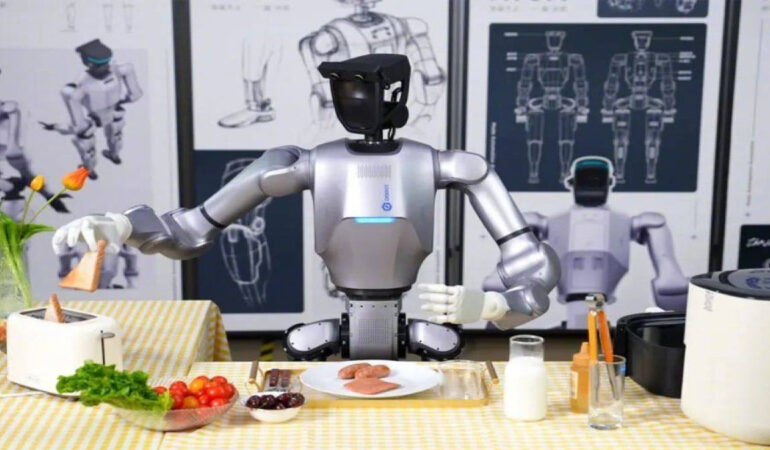
China’s humanoid robot makers are rapidly shifting their priorities from physical movement and mechanical design to advanced artificial intelligence, as the race to commercialise humanoid robots enters a decisive new phase. Companies across the sector are now betting that smarter “brains”, rather than stronger “bodies”, will determine which robots succeed in real world industrial and service applications.
Shenzhen based Dobot this week said it had delivered its third batch of mass produced, full size humanoid Atom robots, marking a transition from experimental prototypes to industrial scale production. The company said the milestone reflected growing confidence that humanoid robots are ready to move beyond controlled demonstrations and into practical use.
At the centre of this shift is Dobot’s self developed vision language action model, known as Dobot VLA. Unlike earlier systems that rely heavily on preprogrammed routines, the model allows robots to perceive their surroundings, interpret ambiguous instructions, and make autonomous decisions in dynamic environments. Dobot said this enables Atom to react to unexpected situations rather than simply follow scripted movements.
The company has already deployed Atom in limited commercial settings, including serving popcorn in a Shenzhen cinema, as a demonstration of how adaptive intelligence can unlock real world applications. Dobot said the ability to understand tasks in context and adjust actions accordingly is the foundation for creating value in manufacturing, logistics, and service industries.
Dobot is not alone in pivoting toward intelligence driven development. Cross town rival UBTech recently open sourced its Thinker multimodal model, designed specifically for humanoid robots. The model, built on a large parameter architecture, aims to address common issues such as response delays and spatial inaccuracies that have long limited humanoid performance.
According to UBTech, its Walker S2 robot achieved nearly perfect accuracy in factory based tasks such as moving boxes and sorting components when powered by the new model. The company also said its Think 4B variant outperformed comparable models developed by Nvidia and ByteDance in several global benchmarks for embodied artificial intelligence.
Industry observers say the shift reflects a broader maturation of China’s robotics sector. Early humanoid demonstrations often focused on visually impressive stunts that masked limited intelligence beneath the surface. Today, the emphasis is on robots that can learn, adapt, and operate reliably in complex environments, a requirement seen as essential for mass adoption.
The commercial momentum is already visible. Global shipments of humanoid robots surged nearly four hundred eighty percent in two thousand twenty five to more than thirteen thousand units, according to research firm Omdia, with Chinese manufacturers accounting for the majority of deliveries.
Despite the rapid growth, challenges remain. Analysts at Morgan Stanley have warned that robust foundation models and access to high quality physical world data remain major bottlenecks. In a recent research note, the bank said capital markets are now prioritising software intelligence in two thousand twenty six, following a focus on hardware in two thousand twenty five and prototypes in earlier years.
Venture capital activity reflects this shift. Shenzhen based LimX Dynamics recently raised two hundred million dollars and unveiled an operating system for embodied AI agents, while X Square Robot completed a one billion yuan funding round to advance robotics foundation models.
Even as intelligence takes centre stage, hardware innovation continues. Shanghai based MirrorMe Tech this week unveiled a humanoid robot capable of running at record speed, underscoring that the race is increasingly about combining capable bodies with intelligent brains. Together, these advances are pushing China closer to making humanoid robots a commercial reality rather than a technological novelty.