China’s Industrial Robotics Deployment Accelerates as Smart Factory Investment Expands in 2026

China’s manufacturing sector is witnessing a significant rise in industrial robotics deployment in 2026 as factories across the country expand investments in smart manufacturing technologies. Industrial automation has become a central pillar of China’s economic modernization strategy, with robotics systems now widely integrated into production lines in sectors such as automotive manufacturing, electronics assembly, battery production, and industrial equipment fabrication. The increasing use of robotics reflects a broader shift toward intelligent manufacturing systems that emphasize productivity, precision, and digital integration across factory operations.
Smart Factory Investment Drives Robotics Expansion
Smart factory development is a major factor behind the growing deployment of robotics in China’s industrial landscape. Manufacturers are upgrading production facilities with automated machinery capable of performing repetitive and highly precise tasks. These upgrades are often combined with digital management systems that monitor production efficiency in real time. Robotics plays a critical role within this environment because automated systems can maintain consistent output quality while reducing operational disruptions caused by manual processes.
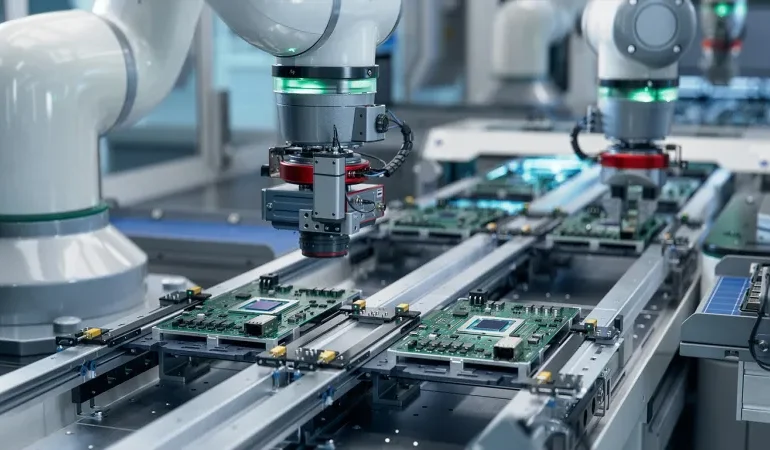
Industrial robots are increasingly deployed for tasks such as welding, assembly, packaging, and material handling. In automotive factories, robotic arms assist with precision welding and painting processes that require exact positioning and uniform application. Electronics manufacturers rely on robotics to assemble delicate components that must meet strict quality standards. These applications illustrate how robotics technology enhances production stability while enabling factories to scale manufacturing capacity more efficiently.
Manufacturing Productivity and Automation
The integration of robotics into manufacturing environments has measurable effects on productivity. Automated systems operate continuously with minimal interruption, allowing factories to increase production throughput without compromising accuracy. Robotics also reduces defect rates by maintaining consistent operational parameters during manufacturing processes.
Many factories now combine robotics with digital monitoring tools that analyze equipment performance and production data. These systems help identify inefficiencies or maintenance requirements before equipment failures occur. Predictive maintenance capabilities supported by data analysis reduce downtime and allow companies to maintain stable production schedules. As a result, robotics investment contributes not only to automation but also to more intelligent factory management practices.
Growth of Domestic Robotics Industry
China’s robotics industry has expanded alongside the growing demand for industrial automation. Domestic robotics manufacturers produce a range of equipment including robotic arms, automated guided vehicles, machine vision systems, and control software platforms. These technologies support a wide variety of industrial applications across manufacturing sectors.
The expansion of domestic robotics companies reflects increasing technological capability within China’s manufacturing ecosystem. Local manufacturers are improving the performance and reliability of robotics equipment while also reducing production costs through scale. As robotics technology becomes more accessible, smaller manufacturing firms are able to adopt automation solutions that were previously limited to large industrial enterprises.
Policy Support for Intelligent Manufacturing
Government policy continues to play a role in encouraging robotics adoption across manufacturing industries. National industrial development programs emphasize the importance of advanced manufacturing technologies and digital transformation in strengthening economic competitiveness. Robotics systems are often included in smart factory initiatives supported by regional governments and industrial development zones.
In many cases, technology demonstration projects showcase how robotics and digital production systems can improve manufacturing efficiency. These projects help manufacturers understand how automation technologies can be integrated into existing facilities while maintaining operational continuity. Policy frameworks that support innovation and industrial upgrading therefore contribute to the rapid expansion of robotics deployment across the country.
Global Competitiveness and Industrial Modernization
China’s investment in robotics is closely connected to its ambition to maintain competitiveness in global manufacturing markets. As labor intensive production becomes less efficient, companies are turning to automation technologies that improve productivity and product consistency. Robotics enables manufacturers to produce complex components with higher accuracy while reducing operational variability.
Export oriented industries particularly benefit from automation because international customers expect reliable product quality and consistent supply chains. Robotics equipped factories can maintain strict quality standards while scaling production volumes to meet global demand. These capabilities strengthen the position of Chinese manufacturers in international markets where technological sophistication increasingly defines competitiveness.
Workforce Transformation in the Automation Era
The expansion of robotics in manufacturing also influences workforce development. Automation does not eliminate the need for human expertise but instead shifts the focus toward technical roles involving robotics programming, system maintenance, and data analysis. Training programs and technical education initiatives are adapting to this transition by emphasizing engineering skills related to automation technologies.
Workers who previously performed manual assembly tasks may now supervise robotic systems or manage automated production lines. This shift toward higher skill employment reflects the broader transformation occurring within China’s manufacturing sector as industries adopt advanced technological capabilities.
Conclusion
China’s accelerating deployment of industrial robotics in 2026 highlights the growing importance of automation in modern manufacturing. Driven by smart factory investment, technological innovation, and policy support, robotics systems are strengthening productivity, improving quality standards, and reinforcing China’s position in the global industrial economy.