China’s Midea Commits 60 Billion Yuan to Accelerate AI and Robotics Development
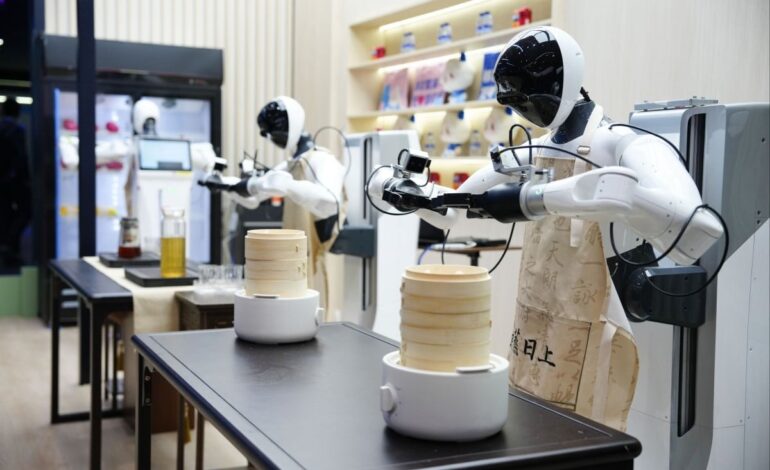
Chinese home appliance giant Midea Group has announced plans to invest 60 billion yuan, about 8.7 billion US dollars, in artificial intelligence and robotics over the next three years as it deepens its transition from traditional manufacturing to advanced automation technologies. The company revealed the new investment plan in Shanghai, signaling a major push toward intelligent machines and next generation industrial automation. Midea said the spending will focus heavily on research and development in areas such as artificial intelligence systems and embodied intelligence, a field that combines AI with physical machines capable of interacting with the real world.
The new commitment reflects the same level of spending Midea directed toward research and development during the past five years combined. Company executives say the move highlights how rapidly industrial automation is becoming central to China’s manufacturing future. Midea, widely known for its consumer appliances, has gradually expanded into robotics and smart manufacturing through major acquisitions and internal innovation. Its ownership of German industrial robot manufacturer Kuka has already placed the company among the world’s important players in industrial robotics, particularly in factory automation and advanced manufacturing systems used by global manufacturers.
A key highlight of the company’s robotics strategy is the development of advanced humanoid machines designed to operate in complex environments. In December, Midea unveiled an experimental humanoid robot known as Miro U. The robot features six arms and moves on a wheeled platform, allowing it to perform multiple tasks simultaneously while maintaining mobility inside factories and logistics facilities. Engineers involved in the project say the design aims to combine precision manipulation with flexibility, enabling machines to handle tasks that traditionally required human workers. Such systems are increasingly being tested in manufacturing plants where automation is expanding rapidly.
Industry analysts say Midea’s aggressive investment reflects a broader shift across China’s manufacturing sector. Many traditional appliance and electronics companies are now channeling large amounts of capital into artificial intelligence and robotics as global competition intensifies. Automation is becoming essential for maintaining efficiency as labor costs rise and factories seek to improve productivity. At the same time, Chinese technology firms are pushing forward in humanoid robotics, industrial automation software, and AI driven control systems that can manage complex production processes with minimal human supervision.
China’s government has also placed significant emphasis on robotics and AI development as part of its long term technology strategy. National policy initiatives encourage companies to integrate intelligent machines into manufacturing, logistics, and services in order to strengthen the country’s industrial capabilities. Robotics investment is increasingly viewed as a critical component of economic modernization, particularly as global supply chains evolve and demand grows for highly automated production systems capable of responding quickly to changing market conditions.
Recent technology exhibitions and global industry events have highlighted the speed of development in humanoid robotics and AI powered automation. Chinese companies are now demonstrating machines capable of performing advanced movements, assembling products, transporting materials, and assisting workers on factory floors. As these technologies mature, analysts expect competition among robotics developers to intensify, especially in areas such as embodied intelligence, industrial AI software, and advanced sensor systems.
Midea’s latest investment plan suggests the company intends to position itself as a central player in this expanding ecosystem. By combining its experience in manufacturing, its robotics subsidiary Kuka, and increased funding for artificial intelligence research, the company is attempting to build a comprehensive automation platform. The initiative also reflects a growing belief among Chinese manufacturers that the next wave of industrial growth will be driven by intelligent machines capable of operating alongside humans in increasingly automated production environments.