China’s New Five-Year Plan Prioritizes Nuclear Modernization to Strengthen Strategic Balance
China is expected to expand and modernize its nuclear forces under the upcoming 15th Five-Year Plan (2026–2030), aligning national security objectives with the goal of preserving what officials describe as the “global strategic balance.”
The proposal, endorsed last week by the Communist Party of China’s Central Committee, emphasizes the development of stronger “strategic deterrence capabilities” as part of Beijing’s broader plan to safeguard peace and maintain equilibrium among major powers.
Analysts say the language marks the first time a national blueprint has explicitly tied nuclear capability to the concept of global stability, reflecting China’s intent to narrow its capability gap with the United States and Russia without pursuing direct parity.
Strategic deterrence and evolving policy language
The latest reference to “strategic deterrence” builds upon statements from previous national plans.
In his 2022 Party Congress report, President Xi Jinping called for building a “strong strategic deterrence system,” while the 14th Five-Year Plan (2021–2025) outlined efforts to achieve “a high-level strategic deterrence capability.”
However, the new proposal is more explicit in linking the modernization of strategic forces to the stability of the global system, suggesting a shift toward integrating China’s nuclear policy with its diplomatic and defense strategies.
Military analysts interpret this as a continuation of China’s long-held doctrine of maintaining a credible but restrained deterrent, ensuring it can withstand a nuclear first strike while avoiding participation in arms races.
The approach underscores Beijing’s principle of “minimum deterrence,” emphasizing reliability and survivability over sheer numbers.
Expansion without escalation
According to the Stockholm International Peace Research Institute (SIPRI), China currently possesses about 600 nuclear warheads, adding roughly 100 per year since 2023.
The United States holds an estimated 5,177 warheads, and Russia approximately 5,459, with both maintaining over 3,000 in military stockpiles.
Analysts at SIPRI and the U.S. Department of Defense project that China’s arsenal could reach 1,000 warheads by 2030 and potentially 1,500 by 2035, still significantly below the levels of Washington or Moscow.
“The focus is not numerical parity but capability balance,” said Timothy Heath, senior international defense researcher at the Rand Corporation.
“China’s goal is to ensure a reliable second-strike capacity, the ability to respond decisively if attacked rather than match U.S. or Russian stockpiles warhead for warhead.”
Heath added that Beijing’s modernization efforts were designed to reduce the risk of nuclear escalation and maintain deterrence stability within the broader framework of non-proliferation.
Strategic balance and national security calculus
Chinese defense experts view the new language as an affirmation of the country’s evolving defense priorities amid intensifying global competition.
Zhou Bo, a retired People’s Liberation Army (PLA) senior colonel and strategic analyst, said the pledge represents a continuation of China’s long-term plan to strengthen its deterrence posture while adhering to its no-first-use nuclear policy.
“This direction ensures that no country dares to contemplate a first nuclear strike against China,” Zhou said.
“Using the U.S. and Russia’s 1,550 deployed warheads under the New START Treaty as a reference, any increase in China’s capability will naturally enhance the sense of strategic balance.”
The New START Treaty, signed by Washington and Moscow in 2010, limits each side to 1,550 deployed warheads and 800 launchers or heavy bombers.
Although Beijing is not a participant in the treaty, analysts say its approach mirrors the underlying logic of strategic restraint while maintaining enough deterrence to dissuade aggression.
Linking modernization to deterrence stability
The proposed five-year plan is part of a broader modernization agenda that includes advancing missile delivery systems, early-warning networks, and command-control architecture.
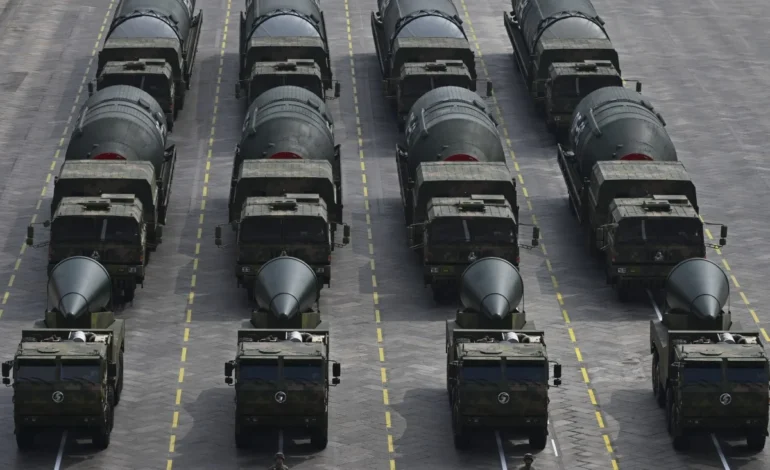
China has already introduced multiple new intercontinental ballistic missiles (ICBMs) and expanded its nuclear-powered submarine fleet.
Military scholars suggest these developments are designed to ensure survivability and communication integrity under potential conflict conditions.
Beijing’s renewed emphasis on strategic balance also reflects its broader diplomatic messaging, presenting its defense modernization as a stabilizing force rather than a destabilizing escalation.
By embedding nuclear development within the framework of “global strategic stability,” the 15th Five-Year Plan aligns China’s military modernization with its stated objective of maintaining peace through deterrence and measured strength.