China’s US$1 Trillion Trade Surplus Raises Questions as Reserves Grow More Slowly
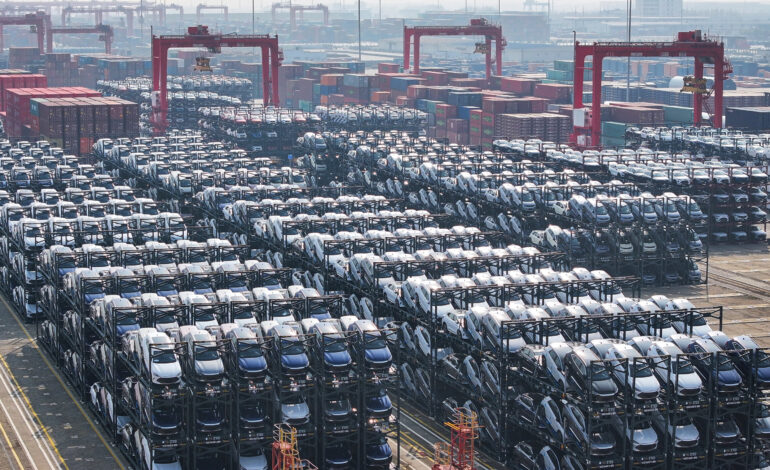
China has recorded a trade surplus exceeding US$1 trillion in the first eleven months of the year, a historic milestone that has drawn global attention. Yet despite the massive inflow suggested by these figures, the country’s official foreign exchange reserves have risen only modestly. This apparent mismatch has prompted economists and investors to ask a simple but important question where is all the money going.
Recent data on China’s external accounts shows that while exports have remained strong and imports relatively subdued, the surplus has not translated into a proportional rise in state held reserves. Analysts say this reflects a fundamental shift in how surplus funds are being managed and deployed across the economy.
Rather than being absorbed mainly by the central bank, a growing share of export earnings is flowing back overseas through private sector channels. Chinese companies and investors are increasingly using foreign currency income to invest abroad, repay external debts, acquire overseas assets, or expand operations outside the mainland. These outflows offset a large portion of the surplus at the official level, keeping reserve growth more restrained.
According to market observers, this trend highlights the changing structure of China’s financial system. In earlier decades, strict capital controls meant trade surpluses almost automatically boosted central bank reserves. Today, while controls remain, firms have far greater flexibility in managing foreign currency, especially for legitimate business activities. This allows surplus funds to circulate globally rather than sitting idle in state accounts.
Han Shen Lin, capstone director for the quantitative finance master’s programme at New York University Shanghai, said the surplus no longer guarantees a parallel rise in official reserves. He noted that a significant portion of foreign currency earnings is now recycled through private channels, reflecting a more diversified pattern of capital use. In this sense, headline trade figures can overstate the impact on China’s state balance sheet.
Another factor is the behaviour of Chinese exporters themselves. Many companies are choosing to hold foreign currency abroad or use it directly for overseas spending, reducing the need to convert earnings into yuan. This limits the amount of foreign exchange that ultimately reaches the central bank, even during periods of record trade performance.
At the same time, policymakers appear comfortable with this outcome. Slower reserve accumulation reduces the pressure on the currency and helps avoid the financial distortions associated with excessive reserve hoarding. It also signals that China’s external accounts are becoming more balanced, even if the trade surplus remains large.
For global markets, the message is nuanced. China continues to generate vast export earnings, but those funds are increasingly dispersed through global investment and corporate activity rather than concentrated in official reserves. This reflects a more mature and outward facing economy, where capital flows respond to business decisions rather than automatic state absorption.
As China’s trade surplus remains under scrutiny, economists say understanding these financial channels is essential. The money has not vanished. Instead, it is moving through a wider network of corporate investments and overseas assets, reshaping how China connects to the global financial system.