Chinese Researchers Slow Quantum Chaos Using 78 Qubit Processor
Chinese physicists have reported a significant advance in quantum research after directly observing and controlling a transitional state known as prethermalisation on a 78 qubit superconducting processor. The breakthrough offers new insight into how quantum systems evolve toward equilibrium and could provide practical tools for stabilizing future quantum computers.
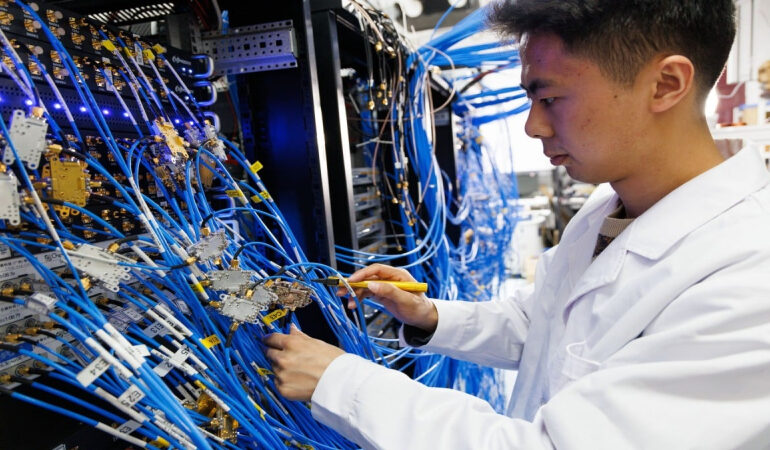
The experiment was carried out using the Chuang tzu 2.0 processor, a superconducting quantum platform developed by researchers at the Institute of Physics under the Chinese Academy of Sciences. By carefully manipulating interactions among qubits, the team was able to observe a prethermal plateau, a temporary state in which a disturbed quantum system appears stable before eventually drifting toward full thermal equilibrium.
In classical physics, systems tend to settle into balance after being disturbed. A swinging pendulum gradually loses energy until it stops. In quantum systems, however, the process is more complex. When energy or information is injected into a quantum system, it spreads through entangled particles in ways that are not fully understood. Prethermalisation represents an intermediate regime where the system behaves as if it has stabilized, even though deeper equilibration has not yet occurred.
Capturing this state experimentally has long been a goal in quantum science. The ability to slow down or tune the approach to chaos allows researchers to better understand decoherence, the process by which fragile quantum states lose information to their environment. Decoherence remains one of the central challenges in building reliable quantum computers, as it limits computation time and accuracy.
Using precise pulse sequences and calibrated interactions, the Chinese team demonstrated control over how quickly the system transitioned out of the prethermal state. By adjusting parameters within the processor, they effectively placed quantum chaos in slow motion, enabling detailed measurement of system dynamics across multiple qubits.
The results have implications beyond theoretical physics. Managing intermediate states could help extend coherence times in quantum processors, improving error mitigation strategies and overall performance. As countries compete to scale up quantum hardware, understanding how to regulate energy flow and entanglement dynamics is becoming increasingly important.
China has invested heavily in superconducting quantum technologies, alongside parallel efforts in photonic and ion trap systems. The Chuang tzu 2.0 platform represents part of a broader push to advance domestic quantum chip capabilities and reduce reliance on foreign technologies in critical computing fields.
While practical quantum advantage in commercial applications remains a long term goal, incremental advances such as controlled prethermalisation deepen scientific understanding and refine hardware control techniques. By experimentally probing how quantum systems approach equilibrium, researchers are building foundational knowledge essential for the next generation of high fidelity quantum processors.