Chinese Rocket Firm LandSpace Advances Toward US$1 Billion Shanghai IPO
A milestone for China’s commercial space sector
Chinese private rocket maker LandSpace has moved a step closer to a landmark public listing after its initial public offering application was accepted through a fast tracked process in Shanghai. The company is aiming to raise about 7.5 billion yuan, roughly US$1 billion, in what would be one of the most significant listings yet for China’s growing commercial aerospace industry.
LandSpace’s progress signals rising confidence in privately developed space technology and highlights how capital markets are increasingly backing strategic industries aligned with national priorities. For China’s space sector, the development represents more than a financing event, marking the maturation of a once experimental segment into a commercially viable industry.
Fast tracked approval reflects policy backing
The acceptance of LandSpace’s listing application through an accelerated review channel is notable. Fast tracked approvals are typically reserved for companies operating in sectors considered strategically important, such as advanced manufacturing, semiconductors, and aerospace.
By granting LandSpace this status, regulators are effectively recognising the role that private rocket firms play in strengthening domestic launch capabilities. This approach aligns with broader efforts to diversify China’s space industry beyond state owned giants and encourage innovation through market competition.
The streamlined process also shortens the timeline to market, allowing companies to raise funds more quickly for capital intensive development.
From start-up to serious contender
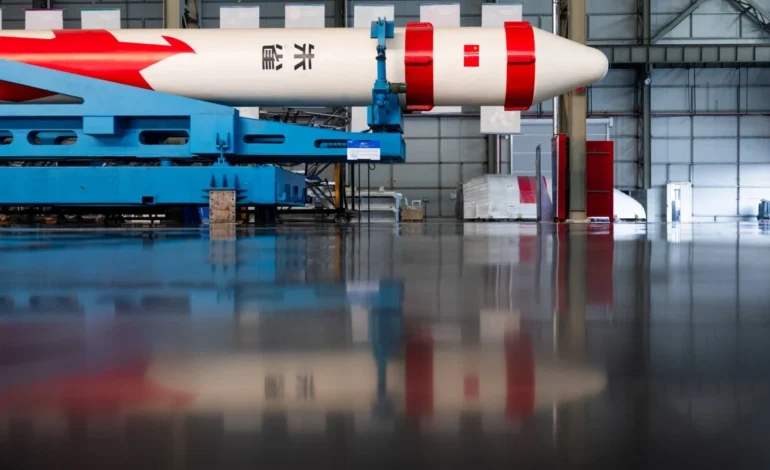
Founded less than a decade ago, LandSpace has emerged as one of China’s most prominent private rocket developers. The company gained national attention after successfully launching its Zhuque series rockets, including methane fuelled designs seen as more cost efficient and environmentally friendly than traditional alternatives.
These technological milestones have helped LandSpace distinguish itself in a crowded field of start-ups. Unlike early entrants that struggled to move beyond testing phases, LandSpace has demonstrated repeatable launch capability, a critical factor for winning commercial and government contracts.
The IPO would provide fresh capital to expand production capacity, refine launch technology, and support long term research.
Investor appetite for space technology
LandSpace’s planned fundraising size suggests strong investor interest in space related assets. Aerospace projects require significant upfront investment and long development cycles, but they also offer high barriers to entry and long term strategic value.
In recent years, Chinese investors have shown growing appetite for companies involved in satellites, launch vehicles, and space based services. These businesses are increasingly viewed as part of the broader high tech manufacturing ecosystem rather than niche ventures.
A successful listing would reinforce the idea that space technology can generate sustainable commercial returns, not just technological prestige.
Shanghai’s role in strategic listings
Choosing Shanghai as the listing venue reflects the city’s positioning as a hub for high tech and science driven companies. Domestic exchanges have become the preferred route for firms operating in sensitive or strategically important sectors, offering policy alignment and access to long term capital.
For LandSpace, a Shanghai IPO provides exposure to investors familiar with industrial and technology cycles, as well as a regulatory environment attuned to the needs of complex engineering firms.
The listing also adds to Shanghai’s growing roster of companies linked to advanced manufacturing and frontier technology.
Competition and challenges ahead
Despite its progress, LandSpace operates in a highly competitive and technically demanding field. Launch reliability, cost control, and customer acquisition remain ongoing challenges. The global space industry is also evolving rapidly, with international competitors pushing reusability and launch frequency.
Public market scrutiny will add another layer of pressure. Investors will expect transparency on costs, timelines, and revenue prospects, areas that can be difficult to forecast accurately in aerospace ventures.
Still, access to public capital could strengthen LandSpace’s ability to compete by providing financial stability and long term funding visibility.
A signal for China’s private space ambitions
LandSpace’s move toward a US$1 billion IPO underscores how far China’s private space sector has come. Once dominated exclusively by state entities, the industry is now attracting private capital and public market participation.
The listing effort reflects confidence that commercial space is no longer experimental, but an integral part of China’s industrial future. As private firms scale up and enter capital markets, they are reshaping how space technology is developed, funded, and deployed.
For investors, LandSpace’s IPO bid offers a rare opportunity to gain exposure to a frontier industry that sits at the intersection of innovation, manufacturing, and national strategy.