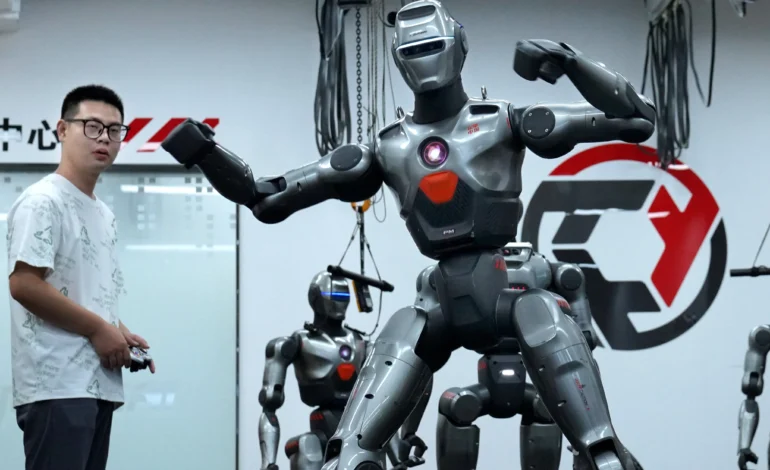
Collaborative Robots Redefine Safety and Efficiency in China’s Smart Factories

China’s manufacturing industry is entering a new phase of automation led by collaborative robots, commonly known as cobots. Unlike traditional industrial robots designed for isolated environments, cobots are engineered to work directly alongside human operators. They are transforming how factories approach productivity, safety, and workforce adaptability. From electronics assembly lines in Suzhou to precision equipment workshops in Shenzhen, cobots are becoming essential to maintaining high output and consistent quality. Their arrival represents a strategic balance between automation and human intuition, a model central to the future of intelligent manufacturing.
The Expanding Role of Cobots in Production
In the past two years, the adoption of cobots across Chinese factories has surged by more than forty percent, according to the China Robotics Industry Alliance. These machines perform delicate, repetitive, and ergonomically challenging tasks such as screwing, welding, packaging, and material handling. Equipped with vision sensors and motion tracking systems, cobots can adjust their speed and strength in response to human proximity. This real-time adaptability ensures safe collaboration without the need for physical barriers. As a result, factories can operate at higher efficiency while reducing occupational injuries and fatigue-related errors.
Policy Support and Market Growth
The Ministry of Industry and Information Technology has included collaborative robotics in its Advanced Manufacturing Development Roadmap for 2026, encouraging industries to adopt human-centric automation. Tax incentives and digital transformation grants are being extended to companies integrating cobots into their production processes. Domestic manufacturers such as AUBO Robotics and Han’s Robot are expanding their product lines to meet growing demand, while global leaders like Universal Robots and ABB have increased their R&D presence in China. The combination of policy momentum and industrial demand is positioning the country as the world’s fastest-growing cobot market.
Enhancing Workplace Safety Through Smart Design
Cobots are built to prioritize safety through lightweight design, pressure sensors, and automated stop mechanisms. These features enable seamless cooperation with human operators without the risk of injury. In industries like medical device assembly and food packaging, where precision and hygiene are critical, cobots perform sensitive tasks that require consistent accuracy and gentle handling. AI-driven cameras allow them to detect obstacles, distinguish between tools and human hands, and adjust their movements in milliseconds. This continuous safety optimization has helped reshape workplace dynamics by allowing humans and machines to share the same operational space harmoniously.
Boosting Efficiency With Artificial Intelligence
Artificial intelligence is now embedded in most next-generation cobots, giving them the ability to learn from repetitive motion and improve performance over time. Machine learning algorithms analyze production data to predict maintenance needs and optimize energy consumption. In electronics manufacturing, cobots equipped with AI vision systems can identify defects in microcomponents more accurately than human inspectors. These intelligent systems not only enhance precision but also reduce downtime and waste, contributing to leaner and more sustainable production cycles.
Empowering the Workforce Through Skill Development
Rather than replacing workers, cobots are redefining their roles. Operators are being trained as robot supervisors, system programmers, and data analysts. The Ministry of Human Resources has launched training programs to help workers transition into new roles within automated environments. Universities in Shanghai and Wuhan have introduced specialized courses on collaborative robotics, combining mechanical design, AI control, and ergonomics. This human–machine partnership is strengthening China’s labor resilience and preparing the next generation of technicians for a digitally integrated economy.
Industrial Applications Across Multiple Sectors
Beyond electronics and automotive manufacturing, cobots are finding applications in logistics, pharmaceuticals, and agriculture. In smart warehouses, they handle sorting and packing; in laboratories, they conduct high-precision pipetting and quality testing. Agricultural cobots are being deployed in greenhouse management and fruit harvesting, using sensors to monitor crop conditions. This diversification shows that collaborative robotics is no longer limited to factory floors they are becoming integral to China’s broader automation strategy across industries.
Shaping the Future of Productive Collaboration
The rise of cobots underscores China’s evolution toward a people-centered industrial model. Their flexibility and affordability make automation accessible even to small and medium-sized enterprises that could not previously invest in full-scale robotic systems. As innovation accelerates, future cobots will combine tactile sensitivity, cognitive AI, and cloud connectivity, enabling them to work as true partners rather than tools.
China’s journey toward intelligent manufacturing is no longer defined by speed alone but by harmony between human creativity and robotic precision. Collaborative robots symbolize this transformation, a future where technology enhances human capability and safety while redefining global standards of industrial excellence.